Showing posts with label Qatari Wedding. Show all posts

Monday, May 08, 2017

Wedding Season


With Ramadan approaching, as well as the heat of the summer, everyone is busy getting their weddings out of the way. Someone can correct me but I think no one has a wedding during the Holy Month, at least I've never gone to one then, so people planning on getting married are trying to get it done before the wedding season comes to an end. Last week I went to two weddings and there might be another one next week that I'll go to.

Thankfully for us foreigners the Qataris keep men's weddings surprisingly consistent. You'll go to a tent/hall, you'll go give your congrats to the groom and the groom's father, hang out for a while, maybe watch the singers and sword dancing, then have dinner if you stick around for it (lamb or goat on rice). Every wedding has been like this -- Qataris don't do theme weddings or exotic weddings. Tradition governs everything for the occasion. The only real differences I've seen are whether there are singers (some weddings don't have them) and whether for dinner you'll be seated at tables or sitting on the floor (50/50 chance of one or the other). You don't bring any gifts, and there'll be plenty of waiters walking around with juice, tea, coffee, appetizers, sweets and halwa for guests to snack on before dinner.


My favourite is when they have sword dancing, which is a lovely tradition. The moves aren't difficult, primarily holding a sword up while walking forward in time to the music. I've done it a couple of times myself but only if friends pull me in to do it with them, I'd feel weird just grabbing a sword and joining on my own. It's nice when children run up to do it, they look so cute in their thobes walking around with swords.


Wednesday, January 25, 2017

Government Wedding Halls


A Qatari wedding has to be one of the biggest expenses of a young man's life. Traditionally the groom's family pays for the wedding, although I've heard nowadays some agree to have the bride’s family cover some of it but I don’t think it’s very common. Renting the halls (remember there are two separate wedding parties, one for the groom and one for the bride, so you have to rent two halls), catering, music, jewelry for the bride-to-be and so forth. It adds up. I'm told to rent a hall at a hotel will run QAR 75,000 or more (US$20,000+), and if you want the top hotels be prepared to pay a lot more. Even wedding tents cost a fortune to rent. I discussed the problems of wedding costs a couple of years ago and how the Government was trying to help by building wedding halls for Qataris to rent cheaply. Well I recently attended a wedding celebration at a Government hall, the first time I had been in one.


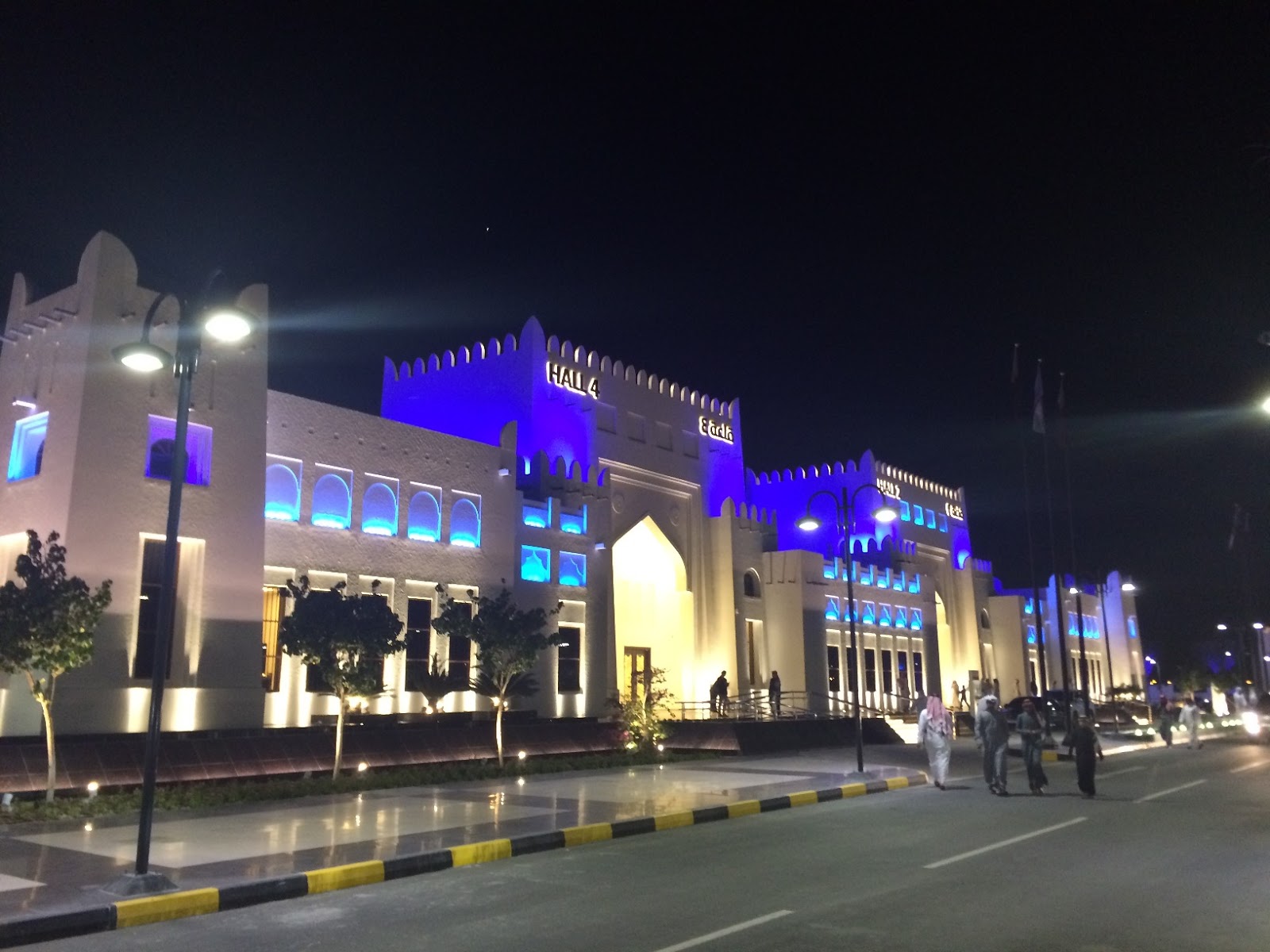
The building was out in a town called Daayan, south of Al Khor. The building was huge! Looked nice, and there was a decent amount of parking around the building. I discovered when I got closer than it contains four halls. At the time two wedding celebrations were taking place so it was a matter of finding a sign with the groom's name to determine which hall I needed to go to.

And here's what it looks like inside the wedding hall.


It was a lot nicer than I expected. I figured it would be something moderately sized and plain given that it was cheap to rent but dang, it was something else.

As I walked across the hall to find the groom I passed a rack of spare swords that people could use for sword dancing.


After I gave the customary congratulations to the groom and his father I waited around for a while chatting with friends until was time for dinner. Dinner was in yet another hall next to the wedding hall.


I can't believe you can rent this cheaply, the Government really made the place look nice.


A few days later I spoke with some of my friends about the wedding halls and they think they're a great idea. I was told that not everybody uses them, especially for the ladies celebration, and some families still prefer the prestige of having them in a nice hotel. To each their own I guess but I wouldn't be willing to pay a ton of extra cash to use a hotel hall if you can rent a Government wedding hall like this for much less.

This idea from the Government gets a thumbs-up.

Sunday, May 22, 2016

Qatar Weddings on Instagram

I always post about weddings that I attend, and there was one last weekend up in Al-Khor. Really nice tent, lots of guests, sword dancing, all in all a good time.


While a men's wedding is relatively casual compared to most Western weddings (no gifts, no pressure to stick around -- you can just show up to give your congratulations and leave) for Qataris showing up is still a serious matter, two of my friends rescheduled a vacation just to make sure they could attend the wedding, even though they'd be there for maybe an hour or so. What's important is that you were there.

Anyway, this time the groom had an e-invitation that he sent around, something that is becoming more and more popular. The invitation has a picture of the groom on a black background with the details of where/when the wedding celebration will take place. From this I learned that there are instagram pages where grooms post wedding invitations and people also post pictures from the wedding.

So if you would like to see a lot of pictures from Qatari Weddings, as well as invitations, check out https://www.instagram.com/a3rasqatar/. You'll get a good idea of what a wedding celebration is like.

Saturday, January 16, 2016

The First Wedding of 2016


With the cooler weather it is “wedding season” in Qatar, as people prefer holding weddings when it is not so hot. Thus I received an invite this week to a colleague’s wedding, Sheikh Abdulla Hamad.

This wedding was held in a large tent on the family’s property.


There were lots of guests of course, wishing the groom well on his marriage. The groom is at the far end of the line, wearing a black bisht over his white thobe.


So I gave my congratulations, and stayed around chatting with people I knew who were also in attendance. Unfortunately I arrived later than expected and missed most of the party, including the dinner. I was expecting it would end around 9:30 or so but I guess because it’s January the evening starts early. Dinner is around the time of Asha prayer, which in this case was around 6:30. I didn’t arrive until 7:30.

Case in point, by quarter after 8 the groom left in the wedding car to go meet his new wife, thus ending the party. I would have been a bit embarrassed if I had arrived later and missed the event, given I told Sheikh Abdulla I’d be there.


So if you get an invite to a Qatari Wedding in the next few weeks aim to be there 6-ish so you don't miss anything.


Saturday, May 16, 2015

Wedding


This week I received an invite to a wedding. As typical for weddings in this part of the world I was told about it with little notice, in this case 2 days in advance. I’ve been here long enough that I wasn’t surprised in the least.

My invite was a text from a mutual friend that there was a wedding on Friday and we were invited. Again a ‘casual’ invitation like this is fairly standard, men’s wedding are open to almost all men to attend so formal invitations are typically given to relatives, friends, and maybe some co-workers. As it was a friend’s brother that was getting married, and I had never met the groom before, there’s no reason why I would receive a formal wedding invitation.

So on Friday evening we were off to the wedding tent.


This wedding had some differences from a typical Qatari wedding as the groom was only half-Qatari, his father was from North Africa, so the wedding was a blend of some Gulf Arab customs and customs from other areas. For example the groom wore a suit, not a white thobe and bisht. I’d never seen his brother wear a thobe either so I was expecting that. For entertainment a Qatari wedding would typically have drums and a group of Arabic singers, with guests occasionally sword dancing. At this wedding the music was from a DJ and the guests themselves were dancing in a circle, something I’ve never seen at a Gulf wedding before.


Dinner was the traditional lamb on rice. Typically we would all sit on the floor to eat (unless the wedding was at a hotel) but at this wedding there were tables for all of the guests to sit at rather than sitting on the floor, again something I’d never seen at a wedding in a tent. The tables were bigger than the platter so guests mostly stood anyway to eat. As per custom there was no cutlery, you were expected to eat with your hand (as in your right hand, never touch communal food with your left hand).


After dinner we hung around for a while longer chatting with friends before heading out. I’m guessing that the groom would be leaving around 11pm to go to where the ladies wedding party was to pick up his wife. Having separate men’s and ladies parties is standard in the Gulf but I spoke to an Algerian friend who told me in North African countries separate parties is also common if you’re having a large number of people over to celebrate.

Best wishes to the groom and his new bride!


Wednesday, December 17, 2014

Wedding Halls


A few times on this blog I've mentioned how despite appearances not all Qataris are wealthy, in fact most of them are in debt. Compounding the issue is a young man trying to get married. Traditionally the groom and his family must pay for the wedding, and after that there is a house to build, expenses to raise a family, and so on. The costs for the wedding alone can be substantial, especially since there are two receptions (one for men and one for women), and these days for a Qatari man to get married he’s probably looking at spending at least $150,000 for the whole thing, and for most it is much more than that.

The costs are starting to have significant implications on Qatari society. Many men are delaying getting married due to the costs, and starting a marriage off in debt can lead to all sorts of problems -- financial issues are one of the main causes of divorce.

The Qatari Government has been trying to resolve these issues and have come up with one way to help reduce the cost of getting married. The Government has opened a new complex with five wedding halls that Qataris can use. The Prime Minister was there for the opening, showing how important the Government feels about the problem of wedding expenses.

The total cost for a Qatari to use the hall for a wedding: QAR 2,500 (~$700). That is way, way cheaper than what they would have to pay to rent a wedding tent (I've been told at least QAR 40,000 or more), or to rent halls at a hotel (QAR 200,000+). Costs have been skyrocketing in the last few years and due to demand private halls charge huge amounts to rent them.

I think more Government wedding halls are under construction. It’s an excellent idea and I hope it will also help to reduce the exorbitant amounts charged by hotels and other hall owners.


Tuesday, May 06, 2014

Qatari Wedding

So I received a call the other day from a friend of mine letting me know that he was getting married (in 3 days) and he invited me to his wedding. That you receive short notice is standard for a Qatari man's wedding, typically you find out a week or less in advance. If you want more information on how Qatari men's weddings work, click on the "Qatari Wedding" tag on the bottom of this post.

So off I went, here's some pictures that a colleague and I took. I didn't ask the groom if I could post his picture on the blog so there are no pictures of him:


The groom is sword dancing in the following picture, he's in the crowd, wearing a black bisht.


And here's dinner . . .


Friday, December 27, 2013

Christmas in Doha


Christmas was pretty busy for me this year. Luckily it was a day off at the office, Christmas is not a public holiday here and many businesses in Qatar don't give it as a holiday. This means while I had the day off for the most part it was just a regular day in the city. All the stores and restaurants were open.

This year the Christmas decorations at malls, stores, and especially hotels were a lot more subdued than previous years. Some friends of mine were telling me about how at hotels like the Ritz there were very few Christmas decorations, and certainly nothing to the extent there were in the past. I discussed this with two different Qataris and both said it was likely due to a more conservative stance by the new Emir, Sheikh Tamim. That doesn't seem unreasonable, recently hotels were ordered to not serve alcohol outside or by the pools so Qatar appears to be getting a little more conservative in regards to non-Muslim activities.

I celebrated Christmas by sleeping in (yay!), then running around picking up a couple of things before heading over to my friend’s for an early Christmas dinner, including turkey, all the trimmings, even pumpkin pie (my favourite). Exchanged gifts of course, and for their daughter I gave her some new clothes. Hopefully she’s still young enough to not care that she received clothes for Christmas, when you’re a kid you eventually reach an age where you hope for toys and clothes are not a ‘cool’ gift.

In the past we've met for Christmas at a hotel buffet but this year my friends decided to host at their place, starting the dinner early so that the young children at the dinner could go to bed at a decent time. Which was great because I had to leave around 7 to go to . . .


. . . a wedding!

Remember how I mentioned that Christmas is not a holiday in Qatar? To Muslims this is just any other day and it just so happened to be the day one of my Qatari friends was getting married. So I went to the hall, chatted with a lot of my friends who were also there for the celebration, gave my congratulations to the groom of course and watched some of the festivities (unfortunately I forgot my camera though). The evening ended at a hotel café on the beach with some of my friends, chatting while they smoked shisha.

It was not a typical Western Christmas but I’ll take it anyday.

Sunday, April 21, 2013

Qatari Weddings – Lighting the House


Around Qatar you will occasionally see a house with strings of lights on it.


This is part of the wedding celebrations, the lights are used to signify that someone in the house has or will be getting married. According to a Qatari friend of mine, the lights are typically put up a few days before the wedding and stay up for a few days afterward (I think some families keep them up longer, I'm sure I've seen houses where those lights are there for a couple of weeks).

And just to clarify, the lights are put up around the time of the wedding parties, not at the time the marriage contract is signed. They are two separate events: the couple signs a marriage contract (at which point they are legally married) but cannot live together until they have had the parties (one for men, and one for ladies). The parties can occur well after the contract is signed, in some cases over a year later.


Saturday, May 12, 2012

Marriage tips from FANAR


So I received this text that FANAR was having a lecture Thursday night on “How to Be Happily Married”. I figured it would be interesting enough and since FANAR is close to Souq Waqif it will be easy to make an evening of it. My friend Murat decided to come along, he is a married Muslim so figured it might be of interest to him as well. We went to the souq and had dinner at Damasca before moseying over to the lecture.


The lecture took place in the main auditorium and there was around 100 men there (ladies sat on the level above so I've no idea how many were there). The speaker was a petroleum engineer for one of the oil companies who in his spare time gives lectures on Islamic topics or holds classes on Islam for children. He was not an Islamic scholar though, which became a bit of a problem during the Q&A as he could not provide comments on matters of religious fatwas, those can only be given by an imam.

Anyway I found out that this was first in a series of four lectures, spending 45 minutes on the types of things one should look for in a marriage partner. Not surprisingly Islamic devoutness was a key consideration and was the focus of much of the discussion.

During the Q&A one lady had a question about whether a man could have a secret second marriage (i.e. marry a second wife but not tell the first one). The speaker was unable to give a response on this as it was more an issue of fatwa but two people in the crowd had their opinion and so when it was their turn to ask a question instead tried to answer the lady’s question. Both believed the answer was no, you can't keep that secret. One even said that you need the permission of the first wife to marry again but something in the back of my mind was telling me that's not correct. A bit of Googling later and the general consensus is that you do not need her permission to marry again:


I also found a video by a scholar I met previously, Dr. Zakir Naik, who states that while it would be preferable permission from the first wife is not a requirement, however informing the first wife is a requirement. (For my meeting with Dr. Naik: Part 1, Part 2)

Finally, there was a question from a Qatari gentleman about how one should assess someone's devoutness to Islam. Apparently there was a potential suitor for his sister and he wanted views on how thorough of an assessment one needs to make. The speaker was of the view that one needs to go a little deeper than simply determining whether the man prays five times a day and goes to the mosque on Friday. Having discussions with his associates or other family members should help determine whether he is a good Muslim. I know this type of "due diligence" is typical in Qatar when Qataris are assessing potential spouses.

The lecture ended and Murat & I went back to the souq to get a juice and chat. Murat joked that his wife said she would accept him having another wife if their two friends A & B got married again. The joke was that they both knew if either of those guys got a second wife their first wife would probably kill them. ;-)

Overall the lecture was okay but I didn't learn a lot. If I'm around for any of the other lectures I'll probably stop by. One of the topics will be how to be a good husband in Islam, which may have some of that detail that us Westerners are always interested in when we wonder about how Islamic marriages work.

Saturday, April 14, 2012

Qatari Marriage Statistics


The newspaper reported some interesting statistics the other day from a new study, "Marriages & Divorces, State of Qatar, 2010 (Review and Analysis)" by the Qatar Statistics Authority.


Apparently the marriage rate has dropped significantly in the last decade, from 34.9 to 24.1 for men (per 1,000 men) and 32.2 to 23.4 for women. Essentially decreases of around 25-35%! Nothing to be too alarmed about though - for comparison this recent article notes the UK rate is 8.7, this website has the US rate at 6.8, a government study shows Japan at 5.5, and in Canada it's gotten to the point where the government is not going to bother tracking it anymore (I can see why - an internet search showed in 2004 the rate was a mere 4.6! Still above the EU average though). The study attributes the decline in Qatar to the “high level of women's education and their strong access to the labor market, as well as high cost of marriage”.

Now there are some slight differences between the numbers, for example the Qatari numbers includes people aged 15 and above where other countries tend to use anywhere from 16-18, but even if you adjusted for that the differences between Qatar and the West are huge.

I'm not surprised there is such a large difference. If you recall marriages in Qatar are arranged and it is expected that a man will get married anywhere around age 22 to 27. I believe it is rare to find a Qatari man over the age of 30 who has never been married. Compare that to the West where lots of people never get married.

I find it interesting that the study feels the marriage rate is declining due to the expense of getting married (I believe it, click on my “Qatari Weddings” category to get an idea how much weddings cost) and because women were delaying marriage due to university and work. End result -- she wants to delay marriage because of education and he wants to delay marriage so he can save up for it (in Qatar the groom is supposed to pay for the wedding). I think there might be another factor as well, declining birth rates. Most of my Qatari friends come from families of around five children whereas I think not so long ago the average family size was even bigger than that. If birthrates have been declining over the last 30 years or so then there will be fewer people in their 20s then there were 10 years ago.


Now for my favorite statistic -- how many Qatari men who got married in 2010 already had one or more wives? Muslim men are allowed to have up to four wives, but how many in Qatar actually do? (Make a guess and then scroll down)


It turns out that 93.9% of men who got married in 2010 had no other wives. 5.5% already had one wife, and 0.5% already had two or three wives. So only about 6% of Qatari men have more than one wife.

So was it close to your guess? I thought polygamy would be a more common than that. Clearly even when allowed to have multiple wives most men are fine with one. I think Westerners just assume that it is a lot more common. Maybe in the past it was.


The study also tracked how many marriages were between first cousins, as well as between second cousins. Cousin marriage is acceptable in Islam and in many Muslim countries quite common (I believe in some areas of Central Asia it can be greater than 50%). This of course can create genetic problems, not so much from one first cousin marriage, but if the cousins were more closely related because parents or grandparents were also first cousins then the chance for genetic problems increases dramatically. In Qatar genetic screening is done if the couple is even distantly related.

It turns out that 26% of the Qatari marriages in 2010 were between first cousins, and an additional 21% was between second cousins. Unfortunately the statistics do not tell us whether the rate has changed over time. I suspect the rate has gone down a bit but that is only from anecdotal evidence based on discussions with my Qatari friends, many of whom told their families they do not want to marry a first cousin.

The Qatar Statistics Authority does publish some interesting stuff, I suggest that anyone really wanting to learn a lot about Qatar look at some of the studies they have done. You can learn a lot about the population this way.

Thursday, December 29, 2011

More Qatari Weddings


It is apparently "Wedding Season" here in Qatar as I just got back from another wedding. A friend of mine told me about the wedding today and asked if I wanted to come along. Seeing as it was the brother of an acquaintance of mine, and I may have met him once, in Qatar that's close enough familiarity to attend their wedding! (like I said before, Qatari men's weddings are open to pretty much any man) It's all about congratulating the groom and his family after all.

So we got there about 8:00 pm. This time instead of a tent it was held in a local sports hall. The floor was covered with carpeting and when we arrived there were already many guests milling about.


We saw the acquaintance of ours so we approached him first so he could introduce us to his father and his brother (the groom) at the receiving line. The groom and his father were easy to identify as they were wearing white thobes with traditional black bishts. My friend and I then found a place to sit down and chatted for a few minutes then dinner was announced.


Roast lamb on a platter of rice, the traditional meal for Qatari men's weddings. No cutlery, as usual. At least this time I was able to take a picture of the meal. In the foil containers was harris (difficult to explain, kind of like a wheat porridge with finely ground chicken in it). So everyone sat down to eat. Eventually other men such as employees from the sports club and labourers who happened to be nearby also came in for a meal, some joined my friend and I at the platter we were sitting at.


After we finished eating my friend and I washed our hands, said our goodbyes, and left. We were there less than an hour, which is perfectly acceptable in Qatari culture. As an example I also found out from my friend that he attended another wedding that evening before coming to this one, so he attended two weddings in three hours.

One thing that was different about this wedding was that there were no singers or musicians. My friend said that not all weddings will have them, especially indoor ones as they can be quite loud (go to my previous blog post and click on the videos for an example)

Wednesday, December 28, 2011

Another Qatari Wedding


A few days before Christmas I received an invitation to the wedding of a business associate. While I can read Arabic I had a tough time deciphering the invitation because of the fancy calligraphy, I was trying to figure out where the wedding was but couldn't do it (yes, I'm still taking Arabic lessons and probably will for a long time). A Qatari colleague of mine helped me out and gave me directions to where the wedding tent would be.

So on the appointed evening I went to the wedding tent.


As you can see these tents are huge (side note: there doesn't appear to be many people in the tent because I took this picture when dinner was being served so everyone was in the dining tent, in truth hundreds of men attended the wedding)

So when I arrived I followed standard procedure: I followed the carpet to the far side of the tent (the carpet is in the above photo, the long red one that crosses the tent) where the groom and his father were greeting guests. They were easy to spot as they were the only men wearing black bishts. After shaking hands with the groom's father I shook hands with the groom and gave my congratulations, stopped for a few pictures with the groom, then moved on to mingle with the guests and enjoy tea and other drinks being handed out by waiters.

This time the singers and musicians were stationed in the large carpeted area outside the tent. I hung out there to watch them for a while. Occasionally a few guests would do some sword dancing. The groom and his father spent all their time greeting the guests who were arriving, or chatting with relatives.


I arrived what I thought was fairly late, 8:15 pm, as I had been at a friend’s dinner party earlier. In Qatar this is not a big deal, the point of attending a man's wedding is to congratulate him and his family and give your regards. No gifts, no ceremony, and if you are not close to the groom (close friends, relatives) you can even leave after giving your regards. Close friends and relatives should stick around for most of the wedding as a matter of politeness but others are under no obligation to stay for the whole event.

I figured I had missed the dinner, which didn't bother me as I was full. Well imagine my surprise when around 8:45 pm they announced dinner. There was a buffet of appetizers and desserts but the main course was already on the guest’s tables -- whole roast lamb on a platter of rice and lentils, one for each table. In traditional fashion, there was no cutlery, you roll up your right sleeve and eat with your hand (ONLY your right hand, never touch food with your left hand). I'm not great at tearing off chunks of meat and rolling it with rice using just one hand but the Qatari gentlemen who were sitting at the table would sometimes tear off pieces of meat and give it to me, which made things easier. I didn't eat a lot because I was still full from the dinner party earlier but I felt that it would be rude if I didn't eat some food -- a lot of effort must go into preparing whole roast lambs for hundreds of guests. I chatted a bit with the other gentleman at the table, practicing my still-limited Arabic, but I still struggled a lot to follow the conversation.

After eating you go to a small room at the side of the tent were about a dozen portable sinks were set up so that guests could wash their hands after the meal.

As I left the dining tent I saw a couple of dozen men, mostly South and Central Asian, waiting patiently by the door. These men were not guests, I assume they happened to be nearby and saw the wedding tent so entered in the hopes of getting a meal. Unlike a Western wedding reception there is nothing wrong with this at all, as far as I know a Qatari man's wedding is open to all men. The etiquette seems to be that once the guests have finished eating these men can enter and partake of the remaining food -- and believe me there was plenty of food left. I've attended two weddings that were held in wedding tents and this occurred both times (the other weddings I attended were in hotels where this doesn’t occur).

I hung around for a while after dinner to watch the singers and eventually the groom and his father did some sword dancing. I did not have a chance to ask the groom whether posting photos of him would be okay so I’m only going to post photos that keeps his identity hidden. Keep an eye out for a Qatari in a white thobe wearing a black bisht, as opposed to Qataris who are wearing black thobes.


I've also posted some video of the festivities, including sword dancing.

Singers at the wedding

The groom sword dancing with guests

By 10:00 most of the guests had left so I left as well. The groom and his father will continue on to the bride’s wedding reception to pick up the bride.

If you would like to know what happens at a Qatari woman’s wedding a fellow Qatari blogger, Just Kooki, has a four-part post about her experience at a lady's wedding. It's definitely worth a read.


Wednesday, April 13, 2011

Qatari Wedding Photos

I mentioned in my blog a couple months ago that I attended a Qatari wedding (my friend Mohammed) and I've managed to acquire a few photos of the event. Mohammed said it was okay for me to post them.


First, the groom:


Sorry ladies, he's already taken!

(Actually wait a sec -- he can have more than one wife! Guess he’s still available if you don’t mind sharing.)

As the groom he is wearing a black robe called a bisht, which is typically worn only by VIPs, or at special events. Typically only the groom and his father (and perhaps an uncle or the bride's father) will wear it at a wedding. It's a great way to find the groom in a crowded room considering almost all the other Arabs will be wearing white dishdasha as well. Aside from the groom, his or the bride’s father, or an uncle, in the three weddings I have attended I have only once seen a guest wearing a bisht, and I found out later that gentleman was a revered close relative.

My understanding is that typically black bishts are worn in the evening, during the day the bisht will be a lighter color such as brown or yellow. This is not a hard and fast rule, occasionally a black bisht might be worn during the day, but I don't think lighter-coloured bishts are worn in the evening. In every wedding I've attended the groom and his relatives wore black bishts.

And there was sword dancing, here are two of my friends dancing past the singers:


And the groom joined in occasionally, when he wasn't greeting guests:


As an aside I would just like to point out that at least one person is wearing a black thobe. While white is the most common color amongst Qataris, in the winter other colors such as black or brown can be worn. They are made of a thicker material to protect against the cold of winter. If you see a picture of a Qatari in a non-white thobe chances are that the picture was taken in winter.

Thanks for sharing the photos Mohammed, and congratulations. If I can get hold of any photos with me in it I will post those as well.

Thursday, December 30, 2010

Qatari Wedding (Arab Wedding)

Okay, I've got a lot of blogging to catch up on. My Qatari friend is back from his honeymoon and gave me some photos from the wedding! Looking back through the blog I realized I hadn't told everyone what happened at the wedding (see what I mean about backlog).

I met up with a group of friends and we all went to the Sheraton hotel where the wedding was being held after the evening prayer in one of the large conference rooms.

Having the wedding in the hotel rather than a tent definitely makes it a touch more upscale, and expensive. But I don't think this was a typical wedding -- that day another Qatari colleague came to me to show me a full page ad in a local newspaper about my friend's wedding and congratulating him. A full page! My first question was, does the ad mention where the wedding is going to be held? Thankfully the answer was no, or else half of Qatar might have shown up.

When we got there I estimate there was about 100 men there already, and over the course of the evening I estimate that well over 800 people were there at some point or another. My friend (the groom) was at the far end of the room with two other men all wearing black bishts, his father and the bride's father. We immediately went over to shake hands with all three and congratulate them, then got out of the way as there was a lineup. We had an opportunity later to meet up with the groom again to have pictures.


We then spent most of the time chatting amongst ourselves and eating the appetizers provided by various waiters wandering around the crowd. Other colleagues and friends came in and we would chat with them after they had greeted the groom. We also briefly met a couple of ambassadors who had attended the function. It turns out many ambassadors were there. A few other men had shown up also wearing bishts, which meant they were likely VIPs (I found out later that some Ministers from the government attended). No chance that His Highness would be showing up though -- he was in Europe working on last-day efforts to win the 2022 World Cup bid, which as we now know succeeded.

After a while dinner was served in the banquet room next door. Like the previous wedding the main dish was lamb on rice on a platter, with a variety of mezzah in small bowls around the table. The difference in this case from the previous wedding I attended was that all of the food was served on tables and everyone had cutlery. Some Arabs stuck with tradition and used their hands anyway. There was also a dessert buffet.

It was during dinner that we noticed there was a woman eating at the head table, which I found odd because I didn't think women went to the men's wedding. She was Caucasian and not wearing an abaya so she definitely was not a family member. Someone speculated that she was likely an ambassador and so as a representative of a nation be allowed at the men's wedding (I found out later that she was the German ambassador).

After the dinner many returned to the main room where they continued to chat with the groom and occasionally did sword dancing when a group of singers started performing.

Eventually the groom joined them at which point most of the men were dancing.


I don't know this kid but he's dressed to the nines. :-)


The wedding was over by about 10 and I returned home. In the next coming weeks some of the local Arabic newspapers had full page or in one case two-page spreads with photos from the wedding. Looks like the wedding hit the society pages.

A great time was had by all.

Monday, November 29, 2010

Another Qatari wedding (Arab wedding)

So I've done the occasional post about a Qatari friend of mine who was getting married -- well the time has come! He is getting married this week. Naturally, I'm invited, as is almost every other man he knows.

Much like the previous wedding I went to you do not have a lot of build-up, I got the invitation two days ago. That's okay though because unlike the West there are no gifts, no place settings at the table, nor many of the other planning details that go into a Western wedding. In Qatari society it's perfectly acceptable to even just show up, congratulate him, and walk back out the door. No pressure on guests.

Unlike the previous Qatari wedding I went to that took place in a large tent this one is taking place at a prominent hotel. He is the oldest child and his father is a VIP in the government so apparently the celebration has to be a bit more upscale. Qatar society does place some level of expectation on people for how grand the wedding must be, it is something that the government is trying to dissuade people from doing because of the cost, but so far to no avail.

My friend has been very gracious in answering my numerous questions about wedding customs, and knows that I will be posting about it on my blog, but the actual cost of the wedding is something I haven't asked because I feel that's getting a little too nosy. I do know that for a typical wedding (remember there are separate men's and women's functions) you should expect to splash out at least $100,000, not including the gifts and jewelry that go to the bride. My friend's family is probably spending more than that.

Now if you recall technically he's already married; months ago a judge visited the couple and their families and accepted the contract of marriage, but under Qatari culture they are not considered married until they have had this celebration. There is both the men and ladies party where congratulations are excepted, food is eaten, and likely some dancing occurs -- moreso at the women's party I've heard. There is no exchanging vows, an imam overseeing a ceremony, or any other kind of formal ceremony as we know it from a Western wedding. I have asked my friend if there is any specific preparations or ceremonies that he does earlier in the day (the wedding party I'm attending starts after the evening prayer). He said no, there is no other private ceremony he does. After the men's party, which will end 10-ish, he will go to the women's party and leave with the bride. At that point they are considered married by all and sundry.

After that there will be a honeymoon. As of a few days ago my friend still wasn't sure where they were going to go!? Apparently his wife-to-be didn't have any particular preference. I'm guessing the concept of honeymoons is a pretty recent thing, possibly a Western influence. I base this on the fact that he seems somewhat laissez-faire about where their honeymoon will be.

You bet I'll post an update once the party has finished.

Sunday, October 31, 2010

A Qatari Wedding (Arab wedding)

Remember how I was mentioning that a wedding was coming up, and that Qataris don't advertise a wedding too far in advance? Well I received an invitation to a wedding -- and not the friend’s wedding that I had mentioned before, another Qatari was getting married.

I got the invitation two days before the wedding. Yes, two days before. It's okay though, you don't bring gifts to a Qatari men's wedding, all that is expected of you is to show up and congratulate the groom. [As I mentioned before men and women celebrate a wedding completely separate from one another, usually in completely separate venues sometimes kilometers away].

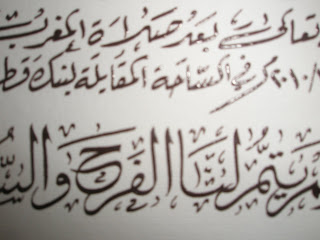
Here's a sample of what the wedding invite looked like. I didn't want to show the whole thing to keep the groom’s identity confidential (I haven't asked him if it's okay to blog about his wedding) but this will give you an idea:


So the evening of the wedding I dressed in a suit and tie and a bunch of us piled into a Land Cruiser and headed out to the wedding tent. Qataris invite almost everyone to a wedding, and for a men's wedding you don't even need to be invited -- one of the guys with us didn't know the groom at all, having recently moved to Qatar only six weeks ago. I'll get into why such a broad invitation is given a little bit later in the blog post. Apparently for the women's wedding it's different and it's usually invite only.

The family had set out a large tent in an empty field to host the men's wedding. Now this tent was easily the size of a large ballroom, necessary to be able to hold potentially hundreds of people, and you need a large space to set it up in for both the tent and the parking for all of the cars. As Qataris are now used to holding such large weddings there is a thriving business in setting up these large tents and the generators for providing electricity for the lights.

So we all entered the tent and the carpeting led us straight across the tent to the other side where the groom and his father were supposed to be receiving the guests. When we arrived it was prayer time so everyone was in the tent praying. We just waited around until they were finished. The groom and his father were easy to spot as they were the only ones wearing a bisht (a thin overrobe that they wear loosely over their white thobe, bishts are typically worn by aristocracy during official meetings and ceremonies but they are also worn by the groom and his father during a wedding). I was with a Qatari friend and I was already primed on what to do -- shake the father's hand and give your congratulations, shake the groom's hand and congratulate him, don't spend too much time chatting as that will hold up the line of other guests waiting to greet the groom and his father, and move on. If you want to chat with the groom there will likely be time later in the evening when things are a bit quieter. Surprisingly the groom paused proceedings for a bit and asked us to all line up next to him and his father for pictures. If I can get a copy of the pictures and get permission to post it I will.

About that time I noticed that there were also a couple of video cameras in the tent. Not handheld ones, real video cameras on tripods, recording the event. There was also a couple of TVs so that if you wanted people could see what was being recorded by the cameras.

Another Qatari that I knew came by for a chat and was holding something belonging to his cousin that he let me hold:


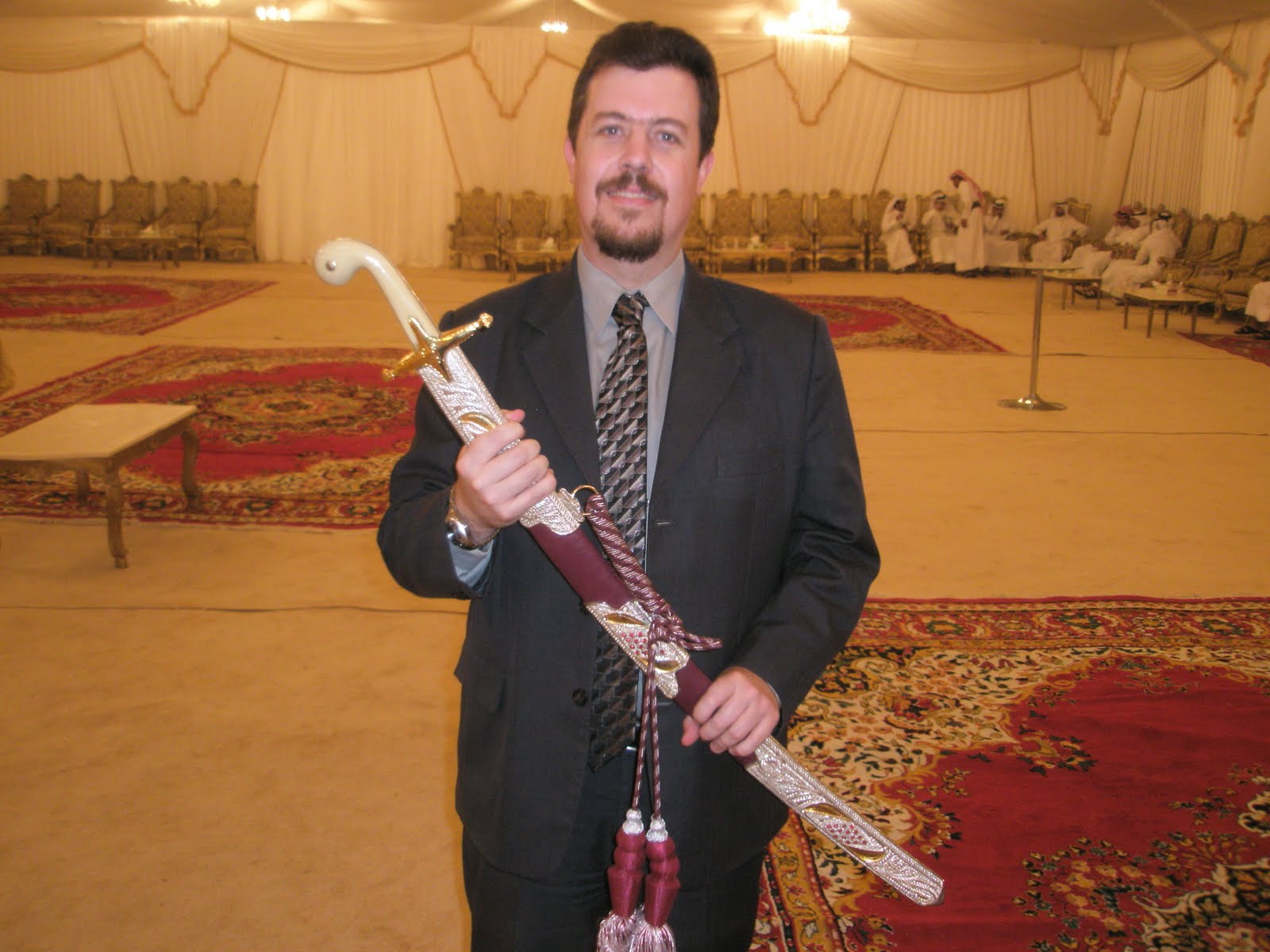
A ceremonial sword, used for the dancing that was to come later. This picture is also good to give you an idea of the size of the tent (you're seeing about a third of the main space). Note that the only chairs are along the walls, I mentioned previously in my blog that in Arab society it is considered impolite at events to sit with your back to someone so chairs/seating are only laid out along the walls. Given that a lot of people will be showing up you need a big tent so that you have space to put all the chairs along the walls.

If you look behind me you'll also see a space that doesn't have chairs, that leads to an entirely separate area where the food will be served. Yes, there is even more space in this tent, an entire dining area.

Then the drums and singers started while some of the guests took their swords and started dancing to the rhythm. I caught a reasonable picture of the festivities:
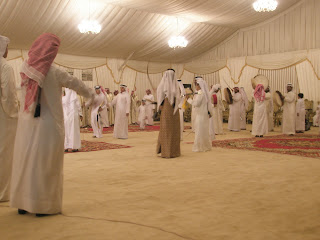


Now don't get me wrong, most of the guests did not have swords with them, in fact I'm guessing about 20 had swords. Most of the Qataris just hung out in the tent and chatted away or ate some of the snacks that were available. Some gathered around to watch the dancing.

Now the Qatari that loaned me the sword for the picture mentioned to me that in the old days the men's wedding was typically held outside. The banging of drums and singing would carry far across the desert and any man hearing it would realize that there was a wedding so would go towards the drums to find out who was getting married and give their congratulations, and possibly eat whatever food was being provided. This is why even today the men's wedding is very open in terms of who is invited, traditionally you didn't send out invitations as any man nearby could show up.

By this point I stopped taking photos. Looking around I noticed that no one seemed to be taking any photographs aside from the official photographer(s) so I wasn't sure if guests taking photos was a cool thing to do.

Dinner was announced so we all moved into the dining area where numerous trays of whole roast lamb on rice had been prepared (and I mean whole -- head and everything). Most of the platters were on the floor and guests immediately sat around the trays and started eating. There was no assigned seating. The family had set up three tables as well so that guests such as us Westerners would not have to eat sitting on the floor.

Now for this dinner, in a traditional Arabic style, there were no plates or cutlery. Guests reach into the food with their right hand, tearing apart bits of meat and grabbing small handfuls of rice, and eat it directly. Always with your right hand, never with your left. Yes it is messy, yes your hand gets all covered with rice and small bits of meat, and yes there are bits of rice all over the place when you're done but that's the way it is. I'd also been told in advance that's what would happen so simply rolled up my sleeve and dug in. There was also bowls with a Qatari dish called haris, meat blended into a type of wheat paste, which tasted somewhat like plain porridge. Since there was no cutlery you just put two fingers in and scooped some to put it in your mouth.

Off to the side was a large area with numerous sinks and soap for guests to clean their hands once they were done. I also noticed that once men had finished eating and left to clean their hands other men would sit down in their place and start eating. At our table this happened at least four times. Near to the end of the dinner I noticed that many of the men were South Asian and not dressed in suits or thobes, so may have been catering employees or just people who happened to be nearby who came by for a meal. By the time I finished cleaning my hands and wandered back into the main tent there were still a lot of people eating and it looked to me like there wasn't going to be any leftovers.

We whiled away the time chatting, watching some more of the singing and dancing, and had an Arabic desert called halwa that was available on the tables near the seats. After a while we went back over to the groom, congratulated him again, had another picture taken with him, and left. All told we were there maybe 2 1/2 hours. By about 10 o'clock or 11 o'clock the groom would be leaving anyway to go pick up his bride at the women's wedding, though I have been told that many will stick around and follow his car to the women's ceremony like a wedding procession.

All told it was a great experience. I should be going to another wedding soon, I'll keep you posted.

Tuesday, July 27, 2010

Qatari wedding update (Arab wedding)

So I had a chat with my friend about marriage contracts and what typically went in them. Without going into details about what is in his marriage contract he did say that typically Qatari marriage contracts will have clauses about the following:

• How much money/jewelry/other things she receives (we might refer to this as a dowry but I believe it is actually called Mahr in Arabic)
• Whether she is allowed to work
• Whether she is allowed to drive (?! This might be the Saudi influence here since in Saudi Arabia women aren't allowed to drive)
• Whether they will have their own home
• Possibly who is responsible for paying for the wedding, this is typically the groom and his family anyway but I was told that nowadays some families split the costs, or the bride's family will pay for the bride's celebration. Weddings are expensive.


My friend did clarify there will be some things you won't see in the contract:

• How many children they will have. (I guess you get as many as Allah gives you)
• Whether he can have more than one wife. The Qur'an allows a man to have four wives so you cannot exclude that right.

I find the pragmatism of the marriage contract to be very interesting. While in the West we will say wedding vows full of more nebulous promises here in Qatar a marriage is a contractual obligation, complete with specific requirements that need to be adhered to. I'm assuming that the bride can petition for divorce for breach of contract should her husband not meet any of the conditions.

Wednesday, July 14, 2010

Qatar Wedding Update (Arab wedding)

An update on my friend's pending nuptials -- apparently the contract has been finalized and presented by the two families to the Court. The Court has accepted the contract so, technically, he is now married!

Similar to when he announced when he was getting married he didn't make a big deal about this part of the process. My understanding is that, culturally speaking, he is not married until the ceremony/celebrations are completed, which may still be a while -- I do not think they have finalized a date yet. Guess there is still time to back out if either party wants to cancel. For now he goes to his fiancée’s (wife’s?) house to chat with her and have dinner with her family. He is also preparing a place where they will live once they have the marriage ceremony. It is good to hear things are going well.

I've been wanting to ask him what exactly is in the contract but I’ve refrained from doing so to respect his privacy. Arabs are generally a private people and can get uncomfortable with questions about their personal life, including asking them about family members. If I'm not mistaken Arabs generally consider it impolite for a man to ask another man about women in his family. Generally you would just ask a man how his family is doing, rather than asking about specific members such as his mother, sister, daughter, wife etc. I'm sure asking about what is in their marriage contract qualifies as very personal information.

As for the contract I do know that the contract has in it that she can work if she wishes to because she currently has a job and he mentioned that she will continue to work there, but I do not know much else. Maybe I will just ask him to give me what details he's willing to share with me (and you as well, he knows I'm blogging about this).

Friday, March 26, 2010

News

So the other day I was chatting with a Qatari colleague about what he got up to over the weekend and after telling me a few things he nonchalantly added on the end...

... "oh, and I got engaged on Thursday."

Oh, was that all! Just a standard weekend then?! :-)

He just didn't know how to tell me. Apparently in Arabic there is a specific phrase one says to people to announce that you got engaged but it has no equivalent in English so he wasn't sure how exactly to break the news to English-speaking people.

Anyway the proper response is "Mabrruk", the Arabic word for congratulations.

This is also a great opportunity for me (and for those of you out there who read this blog) to get a firsthand account of the Qatari wedding process. My colleague said it was okay as long as I don't use names or give away much in the way of personal details.

Now engagements and weddings are not the same throughout the Islamic world, cultural differences play a large role. Gulf Arabs tend to be very conservative and I'm willing to bet their weddings would be very different from a wedding in Indonesia or Lebanon. That said it is extremely difficult to declare certain things about the process to be purely cultural and other things to be purely Islamic -- this region has been Muslim for 1400 years and Islam underpins so much of daily life that the two are fully intertwined to the point where many cultural activities may have had Islamic roots that people don't even really think about anymore, like in the West why 13 is considered an unlucky number or why we say "bless you"after someone sneezes. The best I can do is that in any blog posts about the engagement and wedding if I can find something in the Qur'an or Hadiths directly related to it I'll let you know, otherwise we will have to go on the assumption that it is more strongly influenced by local culture.

Here's what I learned about the engagement process:
-- his parents and her parents agreed that it might be a suitable match, at which point he went with his parents to her house to meet her and her family
-- after the first meeting apparently my friend and the lady both thought it went well so a second meeting with the families was arranged
-- after the second meeting they agreed to be engaged

I think I previously mentioned in my blog that Qataris have arranged marriages, love marriages are not common (actually I've never heard of one but I'm sure they occur at least occasionally).

Anyway, on to some other details:

-- They are not first cousins. I noted once that it is common for first cousins to marry in many parts of the Islamic world, including Qatar, and while I do know one Qatari who married his first cousin it that is not the case this time. [The Qur'an specifically lists who a person is not allowed to marry, first cousins are okay. This is important since if a woman is going to be escorted by a husband or male relative it can't be someone she is eligible to marry]

-- Once engaged many families will allow the lady to go out on dates with her fiancé, chaperoned by one of her male relatives. Many, not all. In the case of my friend that will not be happening. He is allowed to come over to her family's home for dinner though, and they are allowed to talk to each other on the phone so that they can get to know one another.

Naturally to Westerners this seems a bit extreme but I believe it is to protect the reputation of the lady. An engagement does not always mean the couple will get married, if during the course of their chats they determine that they are really not compatible then the wedding will be called off. The lady can then go find a more suitable fiancé with her reputation intact. Now that I think about it perhaps it was wrong of me to say this seems a bit extreme, it actually seems rather Victorian, like a Jane Austen novel, so it wasn't all that long ago that the British would be doing something similar.
[And yes, she should be able to call it off. The Qur'an states that a woman should not be forced to marry. Sadly that rule does not appear to always be applied consistently throughout the Islamic world]

-- The wedding will likely be this upcoming winter when the weather is cooler, in which case the men's celebration can be held outside. The timing of it is still to be decided and will likely depend more on the availability of halls than anything else.

-- They will not be doing anything to determine "auspicious dates" for the wedding. [The Qur'an notes sorcery and other forms of divination is a sin so few Arabs would use astrology and the like to determine favorable times, nor would they believe that certain days would be more auspicious than others]

-- The groom and his family will be paying for the wedding and related celebrations.

-- And I've already been told I'll be invited!

I'll keep updating as more news comes in over the year. I've decided to create new tag, "Qatari wedding" so that it will be easier for people to find all the posts about local weddings.