Friday, July 26, 2013

Ramadan 2013 – Day 16, Katara Lecture and Art Exhibitions


So last night I went to Katara to attend a lecture by Sheikh Saad Al Aatik on "Deliverance from Hellfire". It didn't start until 9:30pm but to get out of the apartment I arrived at Katara around 8:15pm so I could wander around. There wasn't much humidity that night so while it was hot it wasn't so unpleasant that you couldn't walk around.

First I came across a gallery that held modern artworks expressing faith.


I'm not much for modern art so I wasn't sure what to make of it. The glasswork was kind of cool and a few people were getting pictures taken standing behind the glass.

Then I saw another exhibition at a nearby gallery. The title refers to the 99 names of Allah that are found in the Qur’an.


Turns out the artist is primarily a graffiti artist but while there was some artwork definitely inspired by graffiti art . . .


. . . he also had a lot of calligraphy work on display.


Then I stopped for a free Arabic coffee and some dates from a stand that Katara had set up. That was nice of them. Finally it was off to the mosque for the lecture.


Beautiful mosque isn't it? Anyway, Sheikh Al Aatik (on the right with the red gurtra) started off the lecture and after a minute I realized that the entire lecture would be in Arabic! I heard about the lecture through a catalog of events happening at Katara, I wish they had said that the lecture would be in Arabic, I assumed it would be in English because the catalog listing was in English. Don't get me wrong, I can speak a bit of Arabic, but nowhere near enough to follow what was going on, I caught maybe 5% of what he was saying. *shrug*, I sat patiently, admired the mosque, and tried to pick up whatever words I could. After about 45 minutes lecture was over and I left. Shame that I couldn't understand what he was saying.

Anyway, Katara has a lot of events and nice exhibitions on display during Ramadan. If the weather is not too humid I suggest you go there one evening.


Thursday, July 25, 2013

Ramadan 2013 – Day 15, the Qur’an and the Prophet Dawud (David)


Looking at the Prophet David (Dawud in Arabic) in the Qur’an we see that, like my look at the other Prophets, much of the overall history is there but without all of the detail in the Bible. In some ways it appears that it is assumed that the reader of the Qur’an knows much of the history that is referred to in the verse.

The battle with Goliath is only mentioned once, and it covers only 3 verses in the overarching narrative of King Saul. David is only mentioned once:

2:251 So they routed them by Allah's Leave and Dawud (David) killed Jalut (Goliath), and Allah gave him (David) the kingdom and Al-Hikmah (Prophethood), and taught him of that which He willed. And if Allah did not check one set of people by means of another, the earth would indeed be full of mischief. But Allah is full of bounty to the 'Alamin (mankind, jinn and all that exists).

Otherwise the bulk of discussion on David comes from the 38th Surah. First it mentions his ability to either speak to birds or somehow charm birds (it’s unclear to me)

38:18 Verily, We made the mountains to glorify Our Praises with him (David) in the 'Ashi (i.e. after the mid-day till sunset) and Ishraq (i.e. after the sunrise till mid-day).

38:19 And (so did) the birds assembled: all obedient to him (David).


Followed by some verses about David passing judgment on a dispute between two men arguing over some sheep (I won't go into the details here) and concluding with:

38:26 O David! Verily! We have placed you as a successor on the earth; so judge you between men in truth and follow not your desire - for it will mislead you from the Path of Allah. Verily, those who wander astray from the Path of Allah (shall) have a severe torment, because they forgot the Day of Reckoning.

There’s not much more than that. The Qur’an does not contain much else about David and certain stories, such as David’s interactions with Bathsheba and Uriah, are not mentioned at all and generally discounted by Islam. As the Prophets of Islam would be exemplary in following the path of Allah, I'm guessing that Muslims are of the view that there is no way the Prophet David would commit the major sin of adultery as outlined in the tale of Bathsheba. In a similar vein Islam does not believe that the Prophet Isa (Jesus) would be drinking wine since alcohol is forbidden.

However there is something that the Prophet David is famous for in Islam – fasting (which is why I felt investigating the Prophet David was an appropriate thing for Ramadan). The Fast of David is not mentioned in the Qur’an but it is mentioned numerious times in the Al-Bukhari Hadiths, for example:

Book 21:231 Narrated Abdullah bin 'Amr bin Al-'As: Allah's Apostle told me, "The most beloved prayer to Allah is that of David and the most beloved fasts to Allah are those of David. He used to sleep for half of the night and then pray for one third of the night and again sleep for its sixth part and used to fast on alternate days.

Book 55:631 Narrated Abdullah bin Amr: Allah's Apostle said to me, "The most beloved fasting to Allah was the fasting of (the Prophet) David who used to fast on alternate days. And the most beloved prayer to Allah was the prayer of David who used to sleep for (the first) half of the night and pray for 1/3 of it and (again) sleep for a sixth of it."


The fact that David used to fast on alternate days is well-known in Islam and is seen as one of the best fasting regimes. You should not fast any more than that (except daily Ramadan fasting of course as that is mentioned in the Qur’an). Versions of this Hadith appear almost a dozen times in Al-Bukhari:

Book 31:197 Narrated 'Abdullah bin 'Amr: Allah's Apostle was informed that I had taken an oath to fast daily and to pray (every night) all the night throughout my life (so Allah's Apostle came to me and asked whether it was correct): I replied, "Let my parents be sacrificed for you! I said so." The Prophet said, "You can not do that. So, fast for few days and give it up for few days, pray and sleep. Fast three days a month as the reward of good deeds is multiplied ten times and that will be equal to one year of fasting." I replied, "I can do better than that." The Prophet said to me, "Fast one day and give up fasting for a day and that is the fasting of Prophet David and that is the best fasting." I said, "I have the power to fast better (more) than that." The Prophet said, "There is no better fasting than that."


Apparently the Prophet David also used to be frugal in his eating:

Book 34:286 Narrated Al-Miqdam: The Prophet said, "Nobody has ever eaten a better meal than that which one has earned by working with one's own hands. The Prophet of Allah, David used to eat from the earnings of his manual labor."

Book 34:287 Narrated Abu Huraira: Allah's Apostle said, "The Prophet David used not to eat except from the earnings of his manual labor."


I can’t recall when it happened but I do remember meeting one Muslim (and I don't know how the conversation got onto this) who said he had tried the fast of the Prophet David for a month. He said it was extremely difficult given how it disrupted your eating and sleeping patterns. I don’t doubt it.

Wednesday, July 24, 2013

Ramadan 2013 – Day 14, Iftars


Ramadan is the time of year where you receive a lot of invitations to meals. So far this Ramadan I've been out to two iftars and two sohours, with a third sohour coming up this Friday. I've been deliberately trying to reduce the number of times I eat out compared to prior years -- I think the first couple of Ramadans I was out almost every iftar eating at restaurants, which is overdoing it a bit.

I haven't mentioned the two iftars yet. One of them was at a non-Muslim friend’s place. They had guests coming down from the UK so we thought it would be a cool idea to have an iftar so they could see what the custom was like. So I arrived with a variety of dates as well as things like laban and had a nice meal of mixed mezzahs and other Arabic foods. I also cooked my homemade chili, both a spicy and non-spicy version so people could blend it to the desired level of hotness (my spicy chili is mind-blowingly hot). It was perhaps a larger meal than would be standard for an iftar but it was a pleasant meal.

Earlier this week I also received an invitation to an iftar from a friend of mine who works at a nearby taekwondo school. Each Ramadan the owner of the school hosts an iftar for friends and students and when I arrived a number of my friends were already there.

In preparation a number of places had been set up on the floor for the drinks, dates, and food.


Here’s a look at where I sat. The metal dish held a chicken stew called Tharid that is cooked with a base of bread. The platter had pieces of lamb on a bed of rice.


And soon the hall filled up with people ready to break their fast.


When iftar was announced we all sat down on the floor and started eating. There were no utensils, the traditional way to eat meals, so you used your right hand to grab pieces of meat or roll balls of rice in your hand (so you could easily put them in your mouth). You only use your right hand – never the left.

After eating people washed their hands and left for prayer. It was over in less than 30 minutes, iftars are not some multi-our event. A number of us went for coffee after the prayers were over.

Tuesday, July 23, 2013

Ramadan 2013 – Day 13, Qur'an Calligraphy


Last night I went down to Katara to catch some of their Garangao events and happened to walk past a gallery with this sign:


That was certainly worth a look, I did a post about Qur’an calligraphy a year ago on the various styles and how they developed.

One of the first things they had was a great list showing examples of some of the styles:


It may surprise you to find out that each line of calligraphy has the same words in it. It took me a while to figure this out too. While kufic is pretty straightforward for me to read styles like diwani and diwani jali are exceedingly difficult for a beginner like me to decipher. Yet they all say the same thing. It might be in part because written Arabic is read right to left so printed Arabic tends to be very horizontal like kufic, whereas most of the styles here seem to be written almost diagonally or at a sharp angle, from the top right corner to the bottom left.

Now in my original post on calligraphy I mentioned the early Uthman Qur’ans, of which possibly two of those early Qur’ans still survive – the Topkapi Qur’an in Istanbul and the Samarqand Qur’an. At the exhibition were replica copies of both. The Topkapi is the first picture, the Samarqand second. Both are in Kufic but with slightly different style:


The exhibition then discussed the evolution of calligraphy and credits two main historical periods: in Baghdad under the Abbasid Dynasty (roughly 8th to the 13th century) and in Istanbul under the Ottoman period (16th to 20th century). Below is an example from one of the top 16th century Ottoman calligraphers, Ahmed Qurah Hasari.


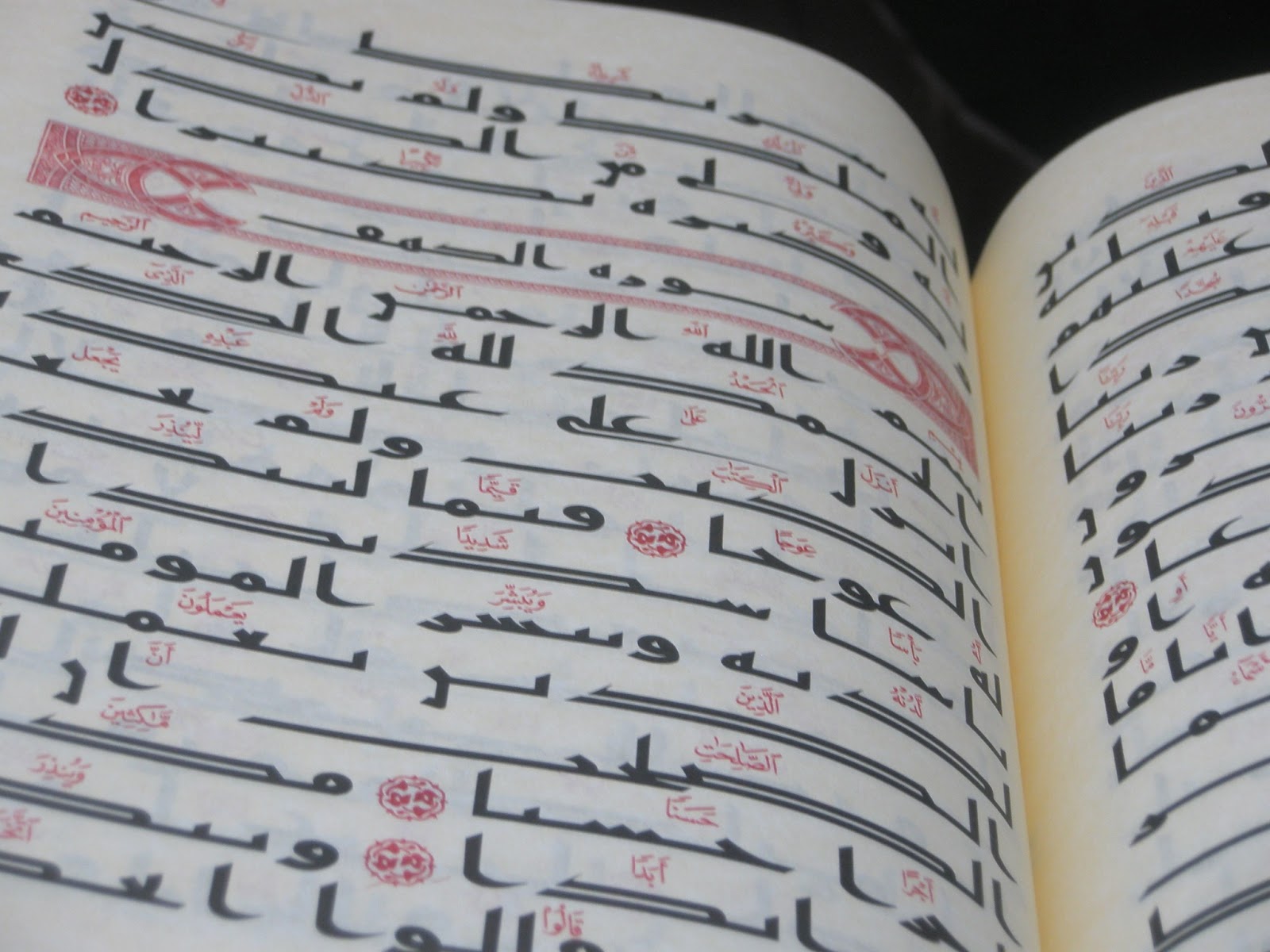
While in most of the examples we see that the calligraphy is quite spaced out, not all Qur’ans were written this way:


But many were incredibly decorative, with a lot of color and artwork, not unlike the level of decoration that went into some of the Medieval Bibles:


Here's a decorative modern example for comparison:


Finally the exhibit had some copies of the earliest printed and translated Qur’ans. The first printed Qur’an was in 1694 in Germany:


The exhibit also had copies of the first Qur’ans printed in Iraq and Saudi Arabia (at the top and bottom of the picture respectively)


And the first translations of the Qur’an date from around that time. A copy in French was first produced in 1649.


It took a while after that for the first translation in English, which was published in 1734.


It was great to have seen that exhibit, especially since I had to leave Katara to meet friends before the Garangao events really started to take off (I keep forgetting things start really late here, people were only starting to show up around 10pm). At least the exhibit made the trip worthwhile.

If you're interested in seeing the exhibit it is in building 22 of Katara.

You can read more about Qur'anic Calligraphy here.

Saturday, July 20, 2013

Ramadan 2013 – Day 10, Corniche Car Show


During Ramadan people spend the late afternoon showing off their cars by driving up and down on the Corniche. I went down to see the show a few times last year and have occasionally been popping by this year as well.


A lot of people park their cars on the side of the road to get pictures.


And a lot of cars are on the road, hundreds come down to be part of the spectacle.


Enjoy!


(What is that? It has Ferrari logos on it but I’ve never seen a Ferrari that small.)


(This one is from last year but it’s still my favourite).

Friday, July 19, 2013

Ramadan 2013 – Day 9, Malaysian Ramadan Bazaar


So I slept in so that I wouldn’t have to have a nap today and hopefully get my sleep schedule back on track. Shortly after the noon prayer was finished my friend Murat called and wanted to meet at a hotel just to chat and while away the time. Like me he prefers not being home since tempting food is within reach so we meet somewhere with good air conditioning where we can sit around. This time we went to the St. Regis Hotel.


We hung out for a couple of hours then I had to go as I wanted to go to the Malaysian Ramadan Bazaar.

Every year during Ramadan the Malaysian Embassy would host a bazaar on the embassy grounds. About 20 tables would be set up by Malays selling home-cooked food. The bazaar is always a great place to stock up on some international food. This year I've not heard any information about it so I asked the Malaysian colleague about the bazaar and she told me it would be today but not at the embassy (maybe because it's too hot outside). This year it would be held at the food court of Hyatt Plaza Mall from 2:30-5:30 and would be held on two Fridays, July 19th and July 26th. So off I went to Hyatt Plaza.

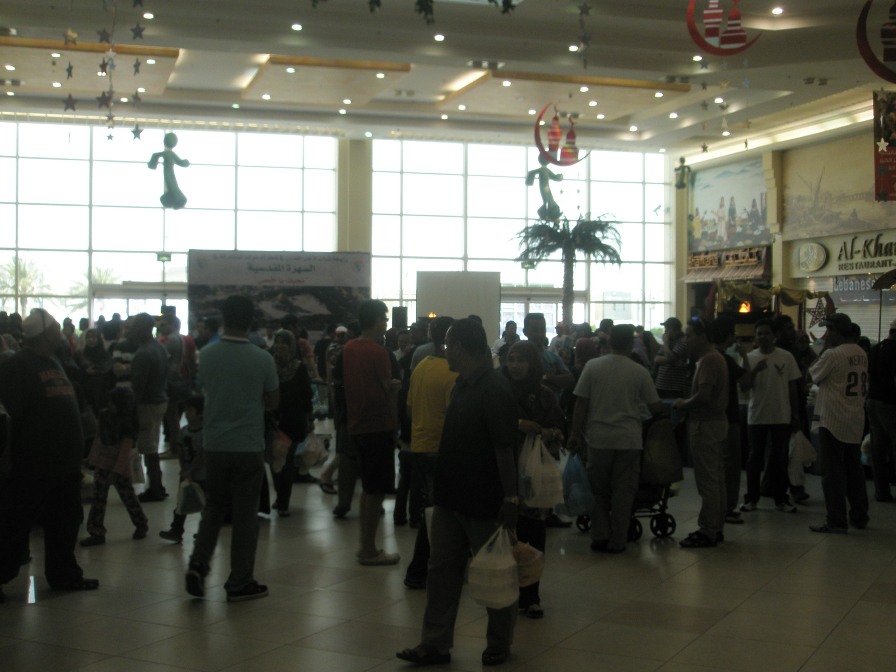
When I got to the food court there was a pretty big crowd:


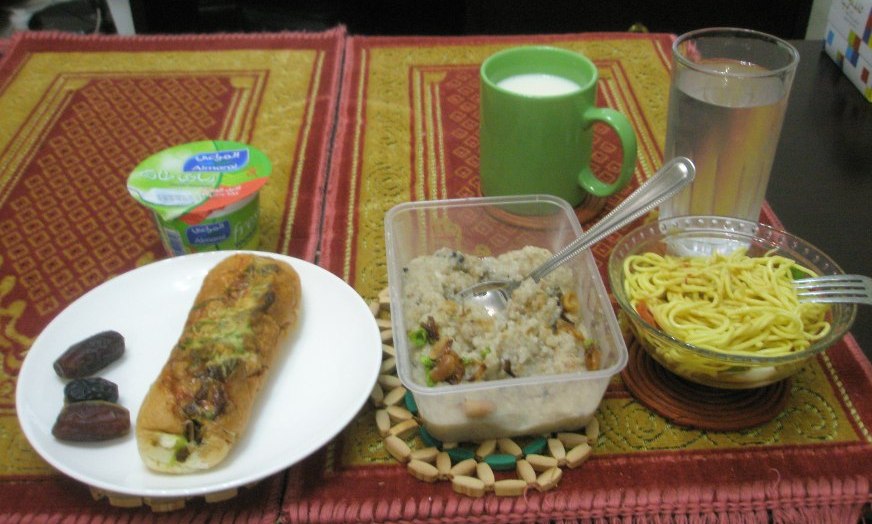
I wandered around, scanning the tables to see what was on offer. One table had a lineup of about 15 people getting what looked like a chicken curry and rice dish. I didn't want to wait -- I might try that one next week. Otherwise I picked up some food from various tables: what looked like a small beef minisub, some type of rice porridge with some spices in it, and noodle dish with a chicken curry sauce (no I have no idea what the Malaysian names of these dishes were, sorry, I've always been bad with names anyway).

So I took it all home and had a Malaysian iftar:


All told the food was QR 25 ($6.75) which I think is a pretty good deal.

If you missed it today you can go next Friday. I probably will.

Ramadan 2013 - Day 8, Sleep Problems


Over the course of Ramadan my sleep schedule has been getting more and more skewed. A typical workday schedule was going like this:

6:15am wake up
7:15am-12:30pm work
2:30pm-4:30ish have a nap
6:30pm iftar
Around 12:30am go to bed
3:00am briefly wake up for sohour

By the time the afternoon rolled around I was very tired and so would fall asleep right away when I had my nap. Because of this, I was usually well rested through the evening and going to bed at night became more difficult, which made me more tired during the day, which made the nap longer, which made it more difficult to fall asleep at night, and so on. I call it “sleep drift”.

The naps have become longer and longer and now are at least three hours. Last night I went to bed at 2:45am, and was still not sleepy. I don't think I actually fell asleep until sometime after 4am! At this rate the evening is going to be the nap and I'll be sleeping most of the day.

Thankfully it's now the weekend so I can try to get this back on track. I woke up this morning around 10:45am and today I'm not going to have a nap at all, I will just have to somehow keep myself occupied all day so I don't sleep. Hopefully that will help reset things, otherwise next week at work is going to be a nightmare.

Wednesday, July 17, 2013

Ramadan 2013 – Day 7, the Qur'an and the Prophet Nuh (Noah)


As part of my Ramadan Qur’an readings I decided to continue on the Prophets topic and look up what the Qur’an had to say about Noah.

Before I begin I want to briefly discuss the length of the two Scriptures. The Qur’an is actually much shorter than the Bible, I did an Internet search on the number of words in the two Scriptures and while estimates varied (especially for the Bible as it would depend on which version you are using) the word count is roughly:

Qur’an 78,000 words
Bible: 775,000 words

So in terms of the length the Bible is around 10 times as long as the Qur’an. I guess that's why we don't have people memorizing the entire Bible, or reciting the entire text over a specific period. During Ramadan one should recite or listen to a reading of the entire Qur’an, if one did it at the same pace as a standard recitation of the Qur’an (30 days) reciting the Bible would take almost an entire year.

This means the Qur’an does not contain the detailed, lengthy stories that the Bible has. As we will see with Noah, the various Prophets are mentioned in the Qur’an, as are key events such as the flood, but not to the level of detail as found in the Bible.

Now the differences in length is a bit misleading because the Islamic world also has an extensive body of literature, such as the Hadiths, which provide guidance as to how a Muslim should conduct himself, whereas in Christianity the Bible is essentially an all-in-one book. If you combined the Hadiths with the Qur’an the body of literature would be as large or larger than the Bible.

So, onto Noah, most of the verses regarding the flood are found in Surah 11, verses 25-48, below are a few select ones:

11:25 And indeed We sent Nuh (Noah) to his people (and he said): "I have come to you as a plain warner."

11:26 “That you worship none but Allah; surely, I fear for you the torment of the painful Day."

But the people didn’t believe him, so . . .

11:36 And it was revealed to Nuh (Noah): "None of your people will believe except those who have believed already. So be not sad because of what they used to do.”

11:37 "And construct the ship under Our Eyes and with Our Revelation, and call not upon Me on behalf of those who did wrong; they are surely, to be drowned."

11:38 And as he was constructing the ship, whenever the chiefs of his people passed by him, they mocked at him. He said: "if you mock at us, so do we mock at you likewise for your mocking.”

11:39 "And you will know who it is on whom will come a torment that will cover him with disgrace and on whom will fall a lasting torment."

11:40 (So it was) till when Our Command came and the oven gushed forth (water like fountains from the earth). We said: "Embarks therein, of each kind two (male and female), and your family -- except him against whom the Word has already gone forth -- and those who believe. And none believed with him, except a few.


11:42 So it (the ship) sailed with them amidst waves like mountains, and Noah called out to his son, who had separated himself (apart): "O my son! Embark with us and be not with the disbelievers."

11:43 (The son) replied: "I will betake myself to some mountain; it will save me from the water." Noah said: "This day there is no saviour from the Decree of Allah except him on whom He has mercy." And waves came in between them, so he (the son) was among the drowned.

11:44 And it was said: "O earth! Swallow up your water, and O sky! Withhold (your rain)." And the water was made to subside and the Decree (of Allah) was fulfilled (i.e. the destruction of the people of Noah). And it (the ship) rested on (Mount) Judi, and it was said: "Away with the people who are Zalimun (polytheists and wrong-doers)!"

(Note that the location of the Ark is not necessarily Mount Ararat, there is debate in the Islamic world as to which mountain it might have been, with some stating that the Qur’an is not specific on this point as “Judi” can mean hill or a high place so might not be a specific name of a place.)

That one of his sons died in the Flood is something not mentioned in the Bible. Even more surprising you find out in a different Surah that Noah’s wife was not a nice person either:

66:10 Allah sets forth an example for those who disbelieve: the wife of Noah and the wife of Lut (Lot). They were under two of our righteous slaves, but they both betrayed them (their husbands by rejecting their doctrine). So they [Noah and Lut (Lot)] availed them (their respective wives) not against Allah and it was said: "Enter the Fire along with those who enter!"

So that’s the key parts of the Great Flood as told in the Qur’an. It lacks a lot of the specifics such as the size of the Ark, the length of the flood, any mention of the dove, etc. A shorter version of the story is retold in Surahs 23: 23-30 and 26: 105-120 as examples of Allah sending Prophets to spread His Word (and what may happen if you do not listen to them). This theme of warning repeats in other sections of the Qur’an:

29:40 So We punished each (of them) for his sins; of them were some on whom We sent Hasib (a violent wind with shower of stones) [as on the people of Lut (Lot)], and of them were some who were overtaken by As-Saihah [torment - awful cry. (as Thamud or Shu'aib's people)], and of them were some whom We caused the earth to swallow [as Qarun (Korah)], and of them were some whom We drowned [as the people of Noah, or Fir'aun (Pharaoh) and his people]. It was not Allah Who wronged them, but they wronged themselves.

There is also an entire Surah named after Noah, Surah 71. The Surah contains 28 fairly-short verses, with most of them describing Noah’s attempts to convince the people to follow Allah, rather than focusing on the Flood itself, such as:

71:5 He said: "Oh my Lord! Verily, I have called to my people night and day.

71:6 But all my calling added nothing to their flight (from the truth).

71:7 And verily, every time I called unto them that You might forgive them, they thrust their fingers into their ears, covered themselves up with their garments, and persisted, and magnified themselves in pride.

71:8 Then verily, I called to them openly.

71:9 Then verily, I proclaimed to them in public, and I've appealed to them in private.”

But there’s one section that I found interesting:

71:26 And Noah said: "My Lord! Leave not one of the disbelievers on the earth!

71:27 If You leave them, they will mislead Your slaves, and they will beget none but wicked disbelievers.”

So in the Qur’an Noah asked Allah to rid the world of the sinners, I believe in the Bible Noah was simply doing the will of God by preparing for the Flood, but did not ask God for it to happen.


Ultimately the story of Noah has some similarities and some differences between the Qur’an and the Bible, though not as different as the discussion of the Prophet Isa (Jesus) that I covered in my last post. The fundamental story of the Great Flood is there, but the circumstances and details differ.

Monday, July 15, 2013

Ramadan 2013 – Day 5, the Quran and the Prophet Isa (Jesus)


Islam is an Abrahamic religion, and many of the people mentioned in the Bible are also mentioned in the Qur’an. I think many Christians in the West fail to understand that so are surprised to hear that the Qur’an discusses Moses (Musa in Arabic), Noah (Nuah), Abraham (Ibrahim) and so forth. And yes, there is a lot of discussion of the Prophet Isa, known in Christianity as Jesus.

Of course when it comes to the Prophet Isa there are some similarities to the Bible and some significant differences.

In Islam the Prophet Isa is a Messenger, like the Prophet Mohammed, who received the word of God. Like the other Prophets he was not divine, a key theological difference from Christianity. The concept of the Trinity is specifically refuted in the Qur’an:

4:159 And there is none of the people of the Scripture (Jews and Christians) but must believe in him ['ÃŽsa, son of Maryam (Mary), as only a Messenger of Allah and a human being] before his ['ÃŽsa’s, or a Jew's or a Christian's] death (at the time of the appearance of the angel of death). And on the Day of Resurrection, he ['ÃŽsa] will be a witness against them.

4:171 O people of the Scripture (Christians)! Do not exceed the limits in your religion, nor say of Allah aught but the truth. The Messiah 'ÃŽsa, son of Maryam (Mary), was (no more than) a Messenger of Allah and His Word, which He bestowed on Maryam (Mary) and a spirit (Ruh ) created by Him; so believe in Allah and His Messengers. Say not: "Three (trinity)!" Cease! (it is) better for you. For Allah is (the only) One Ilah (God), glory be to Him (Far Exalted is He) above having a son. To Him belongs all that is in the heavens and all that is in the earth. And Allah is All-Sufficient as a Disposer of affairs.

5:75 The Messiah ['ÃŽsa (Jesus)], son of Maryam (Mary), was no more than a Messenger; many were the Messengers that passed away before him. His mother [Maryam (Mary)] was a Siddiqah [i.e. she believed in the Words of Allah and His Books]. They both used to eat food (as any other human being, while Allah does not eat).


Because Isa is not divine he should not be worshipped

19:36 ['ÃŽsa said]: "And verily Allah is my Lord and your Lord. So worship Him (Alone). That is the Straight Path. (Allah's religion of Islamic Monotheism which He did ordain for all of His Prophets)."


However, Islam does believe in the virgin birth.

3:47 She said: "O my Lord! How shall I have a son when no man has touched me." He said: "So (it will be) for Allah creates what He wills. When He has decreed something, He says to it only: "Be!” -- and it is.

3:49 And I will make him (Isa) a Messenger to the Children of Israel . . .


Similar verses are repeated in Surah 19 (19-23).


It then continues to list some of the miracles of the Prophet Isa, some of which will be familiar.

. . . saying, "I have come to you with a sign from your Lord, that I design for you out of clay, a figure like that of a bird, and breathe into it, and it becomes a bird by Allah's Leave; and I heal him who was born blind, and the leper, and I bring the dead to life by Allah's Leave. And I inform you of what you eat, and what you store in your houses. Surely, therein is a sign for you, if you believe.”

A key difference here is that the miracles are performed with the will of Allah. My understanding is that Muslims believe the Prophet Isa did not perform these miracles by his own ability but by beseeching God to make it occur. Surah 5:112-115 also gives an example where people ask Isa for the Lord to produce food for them as proof and Allah decides to do so.


What of the crucifixion? This is the most significant split from Christian belief:

4:157 And because of their saying (in boast), "We killed Messiah 'ÃŽsa, son of Maryam (Mary), the Messenger of Allah," - but they killed him not, nor crucified him, but the resemblance of 'ÃŽsa was put over another man (and they killed that man), and those who differ therein are full of doubts. They have no (certain) knowledge, they follow nothing but conjecture. For surely; they killed him not

4:158 But Allah raised him ['ÃŽsa] up (with his body and soul) unto Himself (and he is in the heavens). And Allah is ever All-Powerful, All-Wise.


Yep, according to the Qur’an Jesus was not crucified. Instead Allah took him to Heaven before the crucifixion occurred.


An interesting thing about Isa was that he was able to talk as soon as he was born.

19:23 And the pains of childbirth drove her to the trunk of a date-palm. She said: "Would that I had died before this, and had been forgotten and out of sight!"

19:24 Then [the babe 'ÃŽsa (Jesus) or Jibril (Gabriel)] cried unto her from below her, saying: "Grieve not: your Lord has provided a water stream under you. . . .

19:30 "He ['ÃŽsa] said: "Verily I am a slave of Allah, He has given me the Scripture and made me a Prophet; "


And while it is only touched on here and there, Isa will return during the Day of Judgment. The lecture I attended on the Antichrist noted that the Prophet Isa would fight the Antichrist during the Final Days, similar to what is said in the Bible.

43:61 And he ['ÃŽsa, son of Maryam (Mary)] shall be a known sign for (the coming of) the Hour (Day of Resurrection) [i.e. 'Isa's (Jesus) descent on the earth]. Therefore have no doubt concerning it (i.e. the Day of Resurrection). And follow Me (Allah)! This is the Straight Path (of Islamic Monotheism, leading to Allah and to His Paradise).

That’s the bulk of what is said in the Qur’an on Jesus. While certainly nowhere near as extensive as what is mentioned in the Bible there are some surprising similarities and differences in the life of Jesus when comparing the Bible to the Qur’an.

Sunday, July 14, 2013

Ramadan 2013 - Day 4, Ezdan Mall and Sohour at Katara


So after another weekend morning in the office to while away the time, I had my usual afternoon nap then cooked an iftar at home. I'd agreed to meet a friend at Tim Hortons after the evening prayers, around 10:30pm, so I went earlier in the evening to Ezdan Mall to wander around to see what’s open, as well as spend some time studying some Arabic with a (decaffeinated) coffee.

Out of the malls I've seen recently Ezdan Mall seems to have taken the Ramadan theme more seriously than the others. They had laid out some majlis-style seating throughout the mall:


Had trays with dates for people to snack on. Bottled water was also available.


TV screens were showing video clips accompanied by readings from the Qu’ran


And posters with hadiths were on the walls.


They even had a small stand at the food court with Qatari food (sorry, no pictures of the stand, it was being managed by numerous ladies in abayas and it's considered impolite to take pictures of them)


There was also a charity activity center being set up with singing and games to entertain children. It started around 10pm!


For those of you still wondering what's new at the mall, there were only two more stores open (Collezione and New Yorker) and a couple of things in the food court look close to opening.


After chatting with my friend and leaving the mall I received a text from another friend that he and a couple of other guys were having sohour at Sukar Pasha at Katara. As it was “only” 11:45pm I headed over to Katara. Despite it being almost midnight the traffic around the mall was very congested and it took me around a half hour to get to Katara.

Katara had a nice outdoor display of lights.


Sukar Pasha, the Turkish restaurant at Katara, had expanded for Ramadan by setting up a huge enclosed area, probably seating around 150 people. It was packed full of Qataris all enjoying meals and/or shisha (I’d say mostly shisha as the place was pretty smoky). I met up with my friends and ate a small plate of mixed mezzahs, and we left around 2am. Despite the late hour there were still people at about half the tables by the time we left, despite the fact that fasting would begin in a little over an hour.

Needless to say it's a little weird going to sleep at 2:30am and getting up at 6:30 to go to work. It looks like nowadays I'm getting more sleep during the day than I am in the evening!

Okay, no more about malls. To get this back to a more religious theme next post I'll tell you about Islam and the Prophet Isa (Jesus).