Okay, back to the movies I saw last week at the film festival...
Africa United
Attendance: about 90%
A movie about some kids in Rwanda chasing a dream. One of the kids is apparently an excellent football player and gets spotted by a scout who is holding tryouts in the capital for kids to be part of a team that will perform at the opening ceremony for the World Cup in South Africa. The kid, his "manager" (a street savvy kid who makes soccer balls out of condoms and plastic bags), and the manager's sister take a bus to the tryouts, get on the wrong bus, and wind up in the Congo. Realizing he missed the tryout they all decide to journey to South Africa to catch up with the team. Various hijinks along the way and they also pick up a couple of other people while they travel through various countries in southern Africa.
Overall I liked it and thought it was a pretty entertaining film. The film touched on some pretty deep subjects (HIV, child soldiers, war atrocities, prostitution, poverty) but on many of the subjects it was only touched on in a roundabout way so adults watching the film would understand what they were referring to but a child watching the film probably would not (the film is rated G). Despite the touchy subjects the film is a lot more upbeat than you think.
Rating: 4/5. Worth taking the family to but be warned that there is a bit of PG language
Itto Titrit
Attendance: maybe 20%, but the show did start at 22:30. I felt bad because the director and the producer were there as well.
A film from Morocco and one of the first films to be made in a native Moroccan language – Tamazight. According to the director in the past, for whatever reason, you were not allowed to make films and TV shows in that language. He was very pleased to be able to make this film where the characters all speak Tamazight.
The film takes place in 1950s Morocco in a village up in the mountains. The villagers still live traditionally and deal with a number of dramas: forced marriage, protests against French occupation, education for girls, and dealing with the modern world as it encroaches on their village.
Unfortunately when you shoot a film in a language that is not widely spoken you do not have a wide berth of acting talent to choose from. The acting in this film was generally pretty bad. Also strange was that this film dealt with so many issues, all of which could have made a movie on their own, yet were usually resolved quickly and in many cases offscreen. For example one young woman falls in love with a French soldier, the family plans to make her marry some old guy so she runs off with the soldier. But we never see her leave, run away with the soldier, say goodbye to her family, nothing. We find out she fled when 2 people gossip in the village "can you believe she ran off with that French soldier?” We never see her again. This entire romance and drama took all of about 90 seconds of film split over three scenes. You see the soldier once. One could have made an entire movie on this.
Rating: 2/5. It got a bonus point because at least it showed life in rural Morocco in the 1950s, which I thought was kind of interesting. The acting, lack of on-screen drama, weak script, and what I consider a nonsensical ending kind of killed this movie for me.
My Perestroika
attendance: around 70%, the director and one of the editors was also there
A documentary that follows five people who were all in their teens when the USSR shifted away from communism to capitalism in the early 90s. All five were classmates in the same school and the film shows how they have led such different lives and coped with the changes. One is a successful businessman, a married couple are history teachers, one is a single mother (her fiancé got killed by the Mafia) who repairs billiard tables, and one is a musician who became a punk rock star in the early 90s. They discuss how things have changed, they discuss where they were and what they did during big events in Soviet history, and how by about grade 8 or 9 they could see that the propaganda did not reflect reality.
Rating: 4/5. It was insightful, all of the people followed were pretty intelligent and open in their discussions about their views during those times. The documentary also included a lot of home movie film footage of the people and the events.
Meek's Cutoff
Attendance: I think around 50%, not bad for a late night screening
A Hollywood film set in 1840 following three covered wagons with settlers in it crossing Utah heading towards Oregon, led by a hired guide named Steven Meeks. They get lost, start running low on water, and capture an Indian in the hopes that he can lead them to water. That is pretty much the entire two-hour film summarized right there. This film is slow and contemplative and has a lot of scenes of people crossing prairie and salt plains.
Rating: 1/5. I was waiting for something to happen -- and very little did. I found the ending annoying at first but then realized that at least the film ended. This is definitely a movie for people who like slow, contemplative films but be warned -- this film makes 2001: A Space Odyssey look like a Jet Li flick.
And so ends another Tribeca. I love film festivals, yeah a lot of the films I saw weren't that great but that's the chance you take, some will always be good and some will be bad, but given that many of the films are independent of foreign films there's little chance you'll get another opportunity to see them.
Tuesday, November 02, 2010


Sunday, October 31, 2010
A Qatari Wedding (Arab wedding)
Remember how I was mentioning that a wedding was coming up, and that Qataris don't advertise a wedding too far in advance? Well I received an invitation to a wedding -- and not the friend’s wedding that I had mentioned before, another Qatari was getting married.
I got the invitation two days before the wedding. Yes, two days before. It's okay though, you don't bring gifts to a Qatari men's wedding, all that is expected of you is to show up and congratulate the groom. [As I mentioned before men and women celebrate a wedding completely separate from one another, usually in completely separate venues sometimes kilometers away].
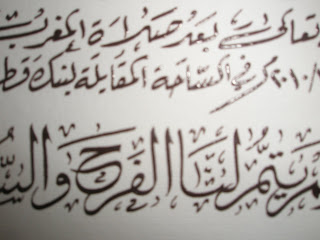
Here's a sample of what the wedding invite looked like. I didn't want to show the whole thing to keep the groom’s identity confidential (I haven't asked him if it's okay to blog about his wedding) but this will give you an idea:
So the evening of the wedding I dressed in a suit and tie and a bunch of us piled into a Land Cruiser and headed out to the wedding tent. Qataris invite almost everyone to a wedding, and for a men's wedding you don't even need to be invited -- one of the guys with us didn't know the groom at all, having recently moved to Qatar only six weeks ago. I'll get into why such a broad invitation is given a little bit later in the blog post. Apparently for the women's wedding it's different and it's usually invite only.
The family had set out a large tent in an empty field to host the men's wedding. Now this tent was easily the size of a large ballroom, necessary to be able to hold potentially hundreds of people, and you need a large space to set it up in for both the tent and the parking for all of the cars. As Qataris are now used to holding such large weddings there is a thriving business in setting up these large tents and the generators for providing electricity for the lights.
So we all entered the tent and the carpeting led us straight across the tent to the other side where the groom and his father were supposed to be receiving the guests. When we arrived it was prayer time so everyone was in the tent praying. We just waited around until they were finished. The groom and his father were easy to spot as they were the only ones wearing a bisht (a thin overrobe that they wear loosely over their white thobe, bishts are typically worn by aristocracy during official meetings and ceremonies but they are also worn by the groom and his father during a wedding). I was with a Qatari friend and I was already primed on what to do -- shake the father's hand and give your congratulations, shake the groom's hand and congratulate him, don't spend too much time chatting as that will hold up the line of other guests waiting to greet the groom and his father, and move on. If you want to chat with the groom there will likely be time later in the evening when things are a bit quieter. Surprisingly the groom paused proceedings for a bit and asked us to all line up next to him and his father for pictures. If I can get a copy of the pictures and get permission to post it I will.
About that time I noticed that there were also a couple of video cameras in the tent. Not handheld ones, real video cameras on tripods, recording the event. There was also a couple of TVs so that if you wanted people could see what was being recorded by the cameras.
Another Qatari that I knew came by for a chat and was holding something belonging to his cousin that he let me hold:

A ceremonial sword, used for the dancing that was to come later. This picture is also good to give you an idea of the size of the tent (you're seeing about a third of the main space). Note that the only chairs are along the walls, I mentioned previously in my blog that in Arab society it is considered impolite at events to sit with your back to someone so chairs/seating are only laid out along the walls. Given that a lot of people will be showing up you need a big tent so that you have space to put all the chairs along the walls.
If you look behind me you'll also see a space that doesn't have chairs, that leads to an entirely separate area where the food will be served. Yes, there is even more space in this tent, an entire dining area.
Then the drums and singers started while some of the guests took their swords and started dancing to the rhythm. I caught a reasonable picture of the festivities:
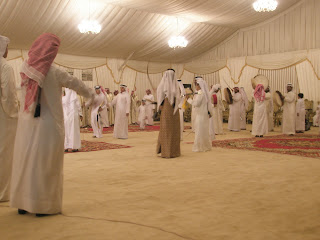
Now don't get me wrong, most of the guests did not have swords with them, in fact I'm guessing about 20 had swords. Most of the Qataris just hung out in the tent and chatted away or ate some of the snacks that were available. Some gathered around to watch the dancing.
Now the Qatari that loaned me the sword for the picture mentioned to me that in the old days the men's wedding was typically held outside. The banging of drums and singing would carry far across the desert and any man hearing it would realize that there was a wedding so would go towards the drums to find out who was getting married and give their congratulations, and possibly eat whatever food was being provided. This is why even today the men's wedding is very open in terms of who is invited, traditionally you didn't send out invitations as any man nearby could show up.
By this point I stopped taking photos. Looking around I noticed that no one seemed to be taking any photographs aside from the official photographer(s) so I wasn't sure if guests taking photos was a cool thing to do.
Dinner was announced so we all moved into the dining area where numerous trays of whole roast lamb on rice had been prepared (and I mean whole -- head and everything). Most of the platters were on the floor and guests immediately sat around the trays and started eating. There was no assigned seating. The family had set up three tables as well so that guests such as us Westerners would not have to eat sitting on the floor.
Now for this dinner, in a traditional Arabic style, there were no plates or cutlery. Guests reach into the food with their right hand, tearing apart bits of meat and grabbing small handfuls of rice, and eat it directly. Always with your right hand, never with your left. Yes it is messy, yes your hand gets all covered with rice and small bits of meat, and yes there are bits of rice all over the place when you're done but that's the way it is. I'd also been told in advance that's what would happen so simply rolled up my sleeve and dug in. There was also bowls with a Qatari dish called haris, meat blended into a type of wheat paste, which tasted somewhat like plain porridge. Since there was no cutlery you just put two fingers in and scooped some to put it in your mouth.
Off to the side was a large area with numerous sinks and soap for guests to clean their hands once they were done. I also noticed that once men had finished eating and left to clean their hands other men would sit down in their place and start eating. At our table this happened at least four times. Near to the end of the dinner I noticed that many of the men were South Asian and not dressed in suits or thobes, so may have been catering employees or just people who happened to be nearby who came by for a meal. By the time I finished cleaning my hands and wandered back into the main tent there were still a lot of people eating and it looked to me like there wasn't going to be any leftovers.
We whiled away the time chatting, watching some more of the singing and dancing, and had an Arabic desert called halwa that was available on the tables near the seats. After a while we went back over to the groom, congratulated him again, had another picture taken with him, and left. All told we were there maybe 2 1/2 hours. By about 10 o'clock or 11 o'clock the groom would be leaving anyway to go pick up his bride at the women's wedding, though I have been told that many will stick around and follow his car to the women's ceremony like a wedding procession.
All told it was a great experience. I should be going to another wedding soon, I'll keep you posted.
I got the invitation two days before the wedding. Yes, two days before. It's okay though, you don't bring gifts to a Qatari men's wedding, all that is expected of you is to show up and congratulate the groom. [As I mentioned before men and women celebrate a wedding completely separate from one another, usually in completely separate venues sometimes kilometers away].
Here's a sample of what the wedding invite looked like. I didn't want to show the whole thing to keep the groom’s identity confidential (I haven't asked him if it's okay to blog about his wedding) but this will give you an idea:

So the evening of the wedding I dressed in a suit and tie and a bunch of us piled into a Land Cruiser and headed out to the wedding tent. Qataris invite almost everyone to a wedding, and for a men's wedding you don't even need to be invited -- one of the guys with us didn't know the groom at all, having recently moved to Qatar only six weeks ago. I'll get into why such a broad invitation is given a little bit later in the blog post. Apparently for the women's wedding it's different and it's usually invite only.
The family had set out a large tent in an empty field to host the men's wedding. Now this tent was easily the size of a large ballroom, necessary to be able to hold potentially hundreds of people, and you need a large space to set it up in for both the tent and the parking for all of the cars. As Qataris are now used to holding such large weddings there is a thriving business in setting up these large tents and the generators for providing electricity for the lights.
So we all entered the tent and the carpeting led us straight across the tent to the other side where the groom and his father were supposed to be receiving the guests. When we arrived it was prayer time so everyone was in the tent praying. We just waited around until they were finished. The groom and his father were easy to spot as they were the only ones wearing a bisht (a thin overrobe that they wear loosely over their white thobe, bishts are typically worn by aristocracy during official meetings and ceremonies but they are also worn by the groom and his father during a wedding). I was with a Qatari friend and I was already primed on what to do -- shake the father's hand and give your congratulations, shake the groom's hand and congratulate him, don't spend too much time chatting as that will hold up the line of other guests waiting to greet the groom and his father, and move on. If you want to chat with the groom there will likely be time later in the evening when things are a bit quieter. Surprisingly the groom paused proceedings for a bit and asked us to all line up next to him and his father for pictures. If I can get a copy of the pictures and get permission to post it I will.
About that time I noticed that there were also a couple of video cameras in the tent. Not handheld ones, real video cameras on tripods, recording the event. There was also a couple of TVs so that if you wanted people could see what was being recorded by the cameras.
Another Qatari that I knew came by for a chat and was holding something belonging to his cousin that he let me hold:
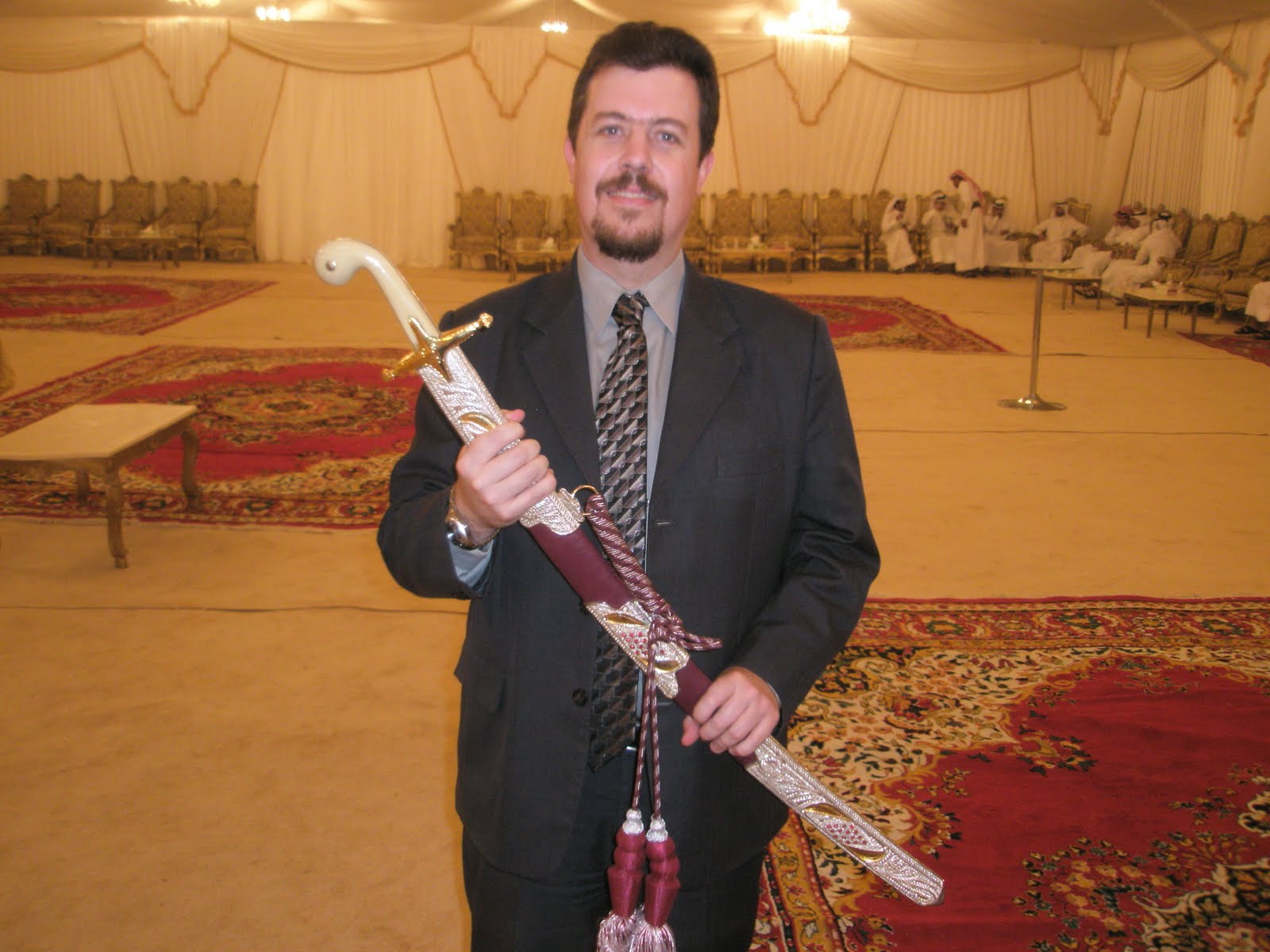
A ceremonial sword, used for the dancing that was to come later. This picture is also good to give you an idea of the size of the tent (you're seeing about a third of the main space). Note that the only chairs are along the walls, I mentioned previously in my blog that in Arab society it is considered impolite at events to sit with your back to someone so chairs/seating are only laid out along the walls. Given that a lot of people will be showing up you need a big tent so that you have space to put all the chairs along the walls.
If you look behind me you'll also see a space that doesn't have chairs, that leads to an entirely separate area where the food will be served. Yes, there is even more space in this tent, an entire dining area.
Then the drums and singers started while some of the guests took their swords and started dancing to the rhythm. I caught a reasonable picture of the festivities:

Now don't get me wrong, most of the guests did not have swords with them, in fact I'm guessing about 20 had swords. Most of the Qataris just hung out in the tent and chatted away or ate some of the snacks that were available. Some gathered around to watch the dancing.
Now the Qatari that loaned me the sword for the picture mentioned to me that in the old days the men's wedding was typically held outside. The banging of drums and singing would carry far across the desert and any man hearing it would realize that there was a wedding so would go towards the drums to find out who was getting married and give their congratulations, and possibly eat whatever food was being provided. This is why even today the men's wedding is very open in terms of who is invited, traditionally you didn't send out invitations as any man nearby could show up.
By this point I stopped taking photos. Looking around I noticed that no one seemed to be taking any photographs aside from the official photographer(s) so I wasn't sure if guests taking photos was a cool thing to do.
Dinner was announced so we all moved into the dining area where numerous trays of whole roast lamb on rice had been prepared (and I mean whole -- head and everything). Most of the platters were on the floor and guests immediately sat around the trays and started eating. There was no assigned seating. The family had set up three tables as well so that guests such as us Westerners would not have to eat sitting on the floor.
Now for this dinner, in a traditional Arabic style, there were no plates or cutlery. Guests reach into the food with their right hand, tearing apart bits of meat and grabbing small handfuls of rice, and eat it directly. Always with your right hand, never with your left. Yes it is messy, yes your hand gets all covered with rice and small bits of meat, and yes there are bits of rice all over the place when you're done but that's the way it is. I'd also been told in advance that's what would happen so simply rolled up my sleeve and dug in. There was also bowls with a Qatari dish called haris, meat blended into a type of wheat paste, which tasted somewhat like plain porridge. Since there was no cutlery you just put two fingers in and scooped some to put it in your mouth.
Off to the side was a large area with numerous sinks and soap for guests to clean their hands once they were done. I also noticed that once men had finished eating and left to clean their hands other men would sit down in their place and start eating. At our table this happened at least four times. Near to the end of the dinner I noticed that many of the men were South Asian and not dressed in suits or thobes, so may have been catering employees or just people who happened to be nearby who came by for a meal. By the time I finished cleaning my hands and wandered back into the main tent there were still a lot of people eating and it looked to me like there wasn't going to be any leftovers.
We whiled away the time chatting, watching some more of the singing and dancing, and had an Arabic desert called halwa that was available on the tables near the seats. After a while we went back over to the groom, congratulated him again, had another picture taken with him, and left. All told we were there maybe 2 1/2 hours. By about 10 o'clock or 11 o'clock the groom would be leaving anyway to go pick up his bride at the women's wedding, though I have been told that many will stick around and follow his car to the women's ceremony like a wedding procession.
All told it was a great experience. I should be going to another wedding soon, I'll keep you posted.
Saturday, October 30, 2010
Doha Tribeca Film Festival
The second annual Doha Tribeca Film Festival has started so I have once again got tickets to a wide variety of films.
I've always liked film festivals because it allows you to see independent films that you might not ever see otherwise. Not that all of the films are independent, I usually see one or two Hollywood films as well, but it looks like this year more of the films are foreign-language, especially from the Middle East and North Africa. I just pick films based on what I think looks interesting, from there it's a real spin of the roulette wheel. Many of the films are not great but occasionally you find real "diamonds in the rough". I remember watching Born into Brothels at the film festival in Bermuda and briefly meeting the directors. Less than a year later they were collecting the Academy Award for best documentary -- beating out the more well-known Super Size Me.
So here's an overview of the first films I saw. At each film you're given a ballot so that you can vote on a scale of 1 to 5 (1 being bad and 5 being awesome), I have also provided the ratings I gave the film:
Waiting for Superman
Attendance: 100% - full house.
A documentary about the state of the US public school system and how in many cities there are charter schools or magnet schools that are also public but do a much better job educating children. Unfortunately these schools only have so much space and always receive more applications than available seats, in some cases 20 times as many,
so each state’s regulations require that the children who are accepted are determined by lottery. The film follows five children and their families, each in different cities, as they try to get their children into the schools so that they will not be stuck in underperforming public schools (some of which are so bad one expert referred to them as "dropout factories"). The film also points out reasons why many public schools don't perform, and talks to various experts or individuals trying to reform the system. The film especially singles out the fact that in almost no state can you fire a teacher thanks to union contracts, allowing really bad teachers to continue educating (charter/magnet schools are allowed to have non-union teachers).
I've always had an interest in education but at times I felt that the film was a bit long on preaching narrative so it dragged in some places. It also didn't seem to give a fair shake to unions and supporters of the public school system to answer the criticisms in the film. That said you do get to know the children and their families, and at the end when the film follows the families to their various lotteries you find yourself wishing that the child's name gets called. The film made it clear, will this child go on to a public school where they will likely not learn much and eventually dropout, or go to a school where the chances of them graduating and going on to college are more than 80%? And it all comes down to their name being drawn out of a box, or that bingo ball matching their number tumbling out. Why does it have to be like this in America?
Rating: 4/5. Definitely worth seeing, though a bit long at times
Legend of the Fist: the Return of Chen Zen
Attendance: 25%, but it was in a huge venue and started at 1030 at night on a weekday.
A Hong Kong (or possibly Chinese) martial arts film that takes place in Shanghai in the 1920s.
First a bit about the venue. This movie was shown at the Four Seasons Hotel on their beach, so patrons sat on beach chairs, toes in the sand, and watched the film on a big screen. Because it was a hotel they served beer. I think it's the first time I'd ever seen a film in a theater that provided beer -- and it was in the Middle East! The weather was pleasant and there were no issues with the sound. Had it been a bit windy here I think the waves lapping up against the shore might have caused a bit of background noise but this night the waters were calm.
As for the film it was a bit all over the place and tried to incorporate too many elements. At times it was a war film, film noir, an action film, a romance, a spy film, a political film, it just didn't seem to know what it wanted to do. A lot of cliché elements to it and the fight scenes weren't that great.
Rating: 2/5. You'd be much better off watching Crouching Tiger, Hidden Dragon, a Bruce Lee film, or Hero.
A Throw of Dice
Attendance: 60%, and it was in the biggest venue at the festival
A free showing of a 1929 silent film about two kings and the lovely Princess they both desire, set in India during the time of the Raj. What made this showing special was that a musical score had been composed for it which was played live by the Qatar Philharmonic Orchestra while the film was being screened.
The venue was the Katara Open-Air Theater at the newly-opened Cultural City. I estimate it could probably seat about 800 people.
The movie was pretty good at it looked to me like it was really set in India and had Indian actors. Because it was the time of the Raj everyone was dressed in elaborate costumes, had huge palaces, tons of servants and so forth. The plot was pretty conventional, an Evil King, a Good King, a love story, and the evil King using rigged dice to get the good King's Kingdom (hence the title). The evil King is defeated, the good King gets his kingdom back and wins the hand of the beautiful princess, and vows never to gamble again. The orchestra did a great job and I don't think the movie would've been quite as good to watch without it.
Rating: 4/5. A unique experience watching a film with a live 75-piece orchestra.
Stone
Attendance: 100%
The newest film with Robert De Niro. Mr. DeNiro and the director were at the screening and said a few words before the movie started.
I won't go into too much detail since this is a new Hollywood film and surely will be available in theaters all over the world. DeNiro plays a prison psychologist who makes recommendations for parole, Ed Norton plays a savvy prisoner, and Mila Jojovich plays Norton's wife who's willing to do anything to get her husband out of jail. DeNiro is clearly unhappy with his life and the film has a lot of characters staring around in existential angst. Too long.
Rating: 3/5. Both a prisoner and an old man unhappy with their lives try to find meaning in it all. While I was watching it I appreciated that A Serious Man by the Coen Brothers did a way better job in covering this kind of theme.
For more movie reviews later but next blog post is about something else altogether...
I've always liked film festivals because it allows you to see independent films that you might not ever see otherwise. Not that all of the films are independent, I usually see one or two Hollywood films as well, but it looks like this year more of the films are foreign-language, especially from the Middle East and North Africa. I just pick films based on what I think looks interesting, from there it's a real spin of the roulette wheel. Many of the films are not great but occasionally you find real "diamonds in the rough". I remember watching Born into Brothels at the film festival in Bermuda and briefly meeting the directors. Less than a year later they were collecting the Academy Award for best documentary -- beating out the more well-known Super Size Me.
So here's an overview of the first films I saw. At each film you're given a ballot so that you can vote on a scale of 1 to 5 (1 being bad and 5 being awesome), I have also provided the ratings I gave the film:
Waiting for Superman
Attendance: 100% - full house.
A documentary about the state of the US public school system and how in many cities there are charter schools or magnet schools that are also public but do a much better job educating children. Unfortunately these schools only have so much space and always receive more applications than available seats, in some cases 20 times as many,
so each state’s regulations require that the children who are accepted are determined by lottery. The film follows five children and their families, each in different cities, as they try to get their children into the schools so that they will not be stuck in underperforming public schools (some of which are so bad one expert referred to them as "dropout factories"). The film also points out reasons why many public schools don't perform, and talks to various experts or individuals trying to reform the system. The film especially singles out the fact that in almost no state can you fire a teacher thanks to union contracts, allowing really bad teachers to continue educating (charter/magnet schools are allowed to have non-union teachers).
I've always had an interest in education but at times I felt that the film was a bit long on preaching narrative so it dragged in some places. It also didn't seem to give a fair shake to unions and supporters of the public school system to answer the criticisms in the film. That said you do get to know the children and their families, and at the end when the film follows the families to their various lotteries you find yourself wishing that the child's name gets called. The film made it clear, will this child go on to a public school where they will likely not learn much and eventually dropout, or go to a school where the chances of them graduating and going on to college are more than 80%? And it all comes down to their name being drawn out of a box, or that bingo ball matching their number tumbling out. Why does it have to be like this in America?
Rating: 4/5. Definitely worth seeing, though a bit long at times
Legend of the Fist: the Return of Chen Zen
Attendance: 25%, but it was in a huge venue and started at 1030 at night on a weekday.
A Hong Kong (or possibly Chinese) martial arts film that takes place in Shanghai in the 1920s.
First a bit about the venue. This movie was shown at the Four Seasons Hotel on their beach, so patrons sat on beach chairs, toes in the sand, and watched the film on a big screen. Because it was a hotel they served beer. I think it's the first time I'd ever seen a film in a theater that provided beer -- and it was in the Middle East! The weather was pleasant and there were no issues with the sound. Had it been a bit windy here I think the waves lapping up against the shore might have caused a bit of background noise but this night the waters were calm.
As for the film it was a bit all over the place and tried to incorporate too many elements. At times it was a war film, film noir, an action film, a romance, a spy film, a political film, it just didn't seem to know what it wanted to do. A lot of cliché elements to it and the fight scenes weren't that great.
Rating: 2/5. You'd be much better off watching Crouching Tiger, Hidden Dragon, a Bruce Lee film, or Hero.
A Throw of Dice
Attendance: 60%, and it was in the biggest venue at the festival
A free showing of a 1929 silent film about two kings and the lovely Princess they both desire, set in India during the time of the Raj. What made this showing special was that a musical score had been composed for it which was played live by the Qatar Philharmonic Orchestra while the film was being screened.
The venue was the Katara Open-Air Theater at the newly-opened Cultural City. I estimate it could probably seat about 800 people.
The movie was pretty good at it looked to me like it was really set in India and had Indian actors. Because it was the time of the Raj everyone was dressed in elaborate costumes, had huge palaces, tons of servants and so forth. The plot was pretty conventional, an Evil King, a Good King, a love story, and the evil King using rigged dice to get the good King's Kingdom (hence the title). The evil King is defeated, the good King gets his kingdom back and wins the hand of the beautiful princess, and vows never to gamble again. The orchestra did a great job and I don't think the movie would've been quite as good to watch without it.
Rating: 4/5. A unique experience watching a film with a live 75-piece orchestra.
Stone
Attendance: 100%
The newest film with Robert De Niro. Mr. DeNiro and the director were at the screening and said a few words before the movie started.
I won't go into too much detail since this is a new Hollywood film and surely will be available in theaters all over the world. DeNiro plays a prison psychologist who makes recommendations for parole, Ed Norton plays a savvy prisoner, and Mila Jojovich plays Norton's wife who's willing to do anything to get her husband out of jail. DeNiro is clearly unhappy with his life and the film has a lot of characters staring around in existential angst. Too long.
Rating: 3/5. Both a prisoner and an old man unhappy with their lives try to find meaning in it all. While I was watching it I appreciated that A Serious Man by the Coen Brothers did a way better job in covering this kind of theme.
For more movie reviews later but next blog post is about something else altogether...
Monday, October 25, 2010
Happy birthday Aiden!
It is my nephew Aiden's birthday today and I've been told that he and his sister had a party earlier this week. I'm going to guess he looked a lot like this afterward:

Hehehehe, that's one of my favorite pictures. It looks like he came back from a college fraternity chocolate-cake party.
Because that was a mean picture here is a much nicer one of him helping me pick apples at Grandma's house:

Happy birthday kiddo! Give Mom & Dad a kiss for me.

Hehehehe, that's one of my favorite pictures. It looks like he came back from a college fraternity chocolate-cake party.
Because that was a mean picture here is a much nicer one of him helping me pick apples at Grandma's house:

Happy birthday kiddo! Give Mom & Dad a kiss for me.
Sunday, October 24, 2010
Museum lectures, part two
The second lecture at the Museum of Islamic Art, on great Arab thinkers, was on a Sufi aesthetic from the eighth century -- Rabia al-Adawiyya
http://en.wikipedia.org/wiki/Rabia_al-Adawiyya
She was born in Basra (Iraq), so unlike the subject of the previous lecture she could definitely be considered an Arab and probably spoke Arabic.
Now Sufism is a type of Islam that tends to be along the more mystic/ascetic lines of spirituality (Whirling Dervishes, who spin around as a form of meditation, are Sufis). A Qatari friend of mine who had experiences with Sufis during his time abroad considered them odd and certainly different from the Wahhabist-Sunni Islam that he followed. I'm not entirely sure of the differences between the different groups, I'll consider researching that further sometime.
What was unusual about this lecture was that it seemed to be more of a hagiography, focusing on details of the lady’s miracles and manifestations of devoutness rather than solid historical facts about her (given that she was born in the eighth century perhaps maybe there wasn't much). http://en.wikipedia.org/wiki/Hagiography
What I found interesting is that all of these tales and stories about Rabia struck me as being very similar to the tales of Christian saints propagated by Catholicism. Miracles, stories of her floating in the air, making lanterns blaze with light, seem to be most of the information about her, not unlike many Catholic saints. It makes me wonder whether the Christian tradition of hagiography had somehow permeated the early Islamic followers who looked for and emulated saints. In fact, until I attended this lecture I didn't realize there was any such thing as an Islamic saint, though it is apparently common in Sufiism.
The lecturer did touch on many of the stories that are indeed linked with Wikipedia article but there were a few differences. Her father did not relate that the Prophet had asked the Amir to give him 400 dinars, that was simply a reward that the Amir gave him for the vision. Apparently no one knew that the Amir observed Darooud so her father telling the Amir that he had missed it last Thursday (the lecturer said it was a Friday, which makes a little more sense since that is a holy day) was all the proof that he needed to know that her father was telling the truth about the vision.
Even more unusual was that she remained celibate throughout her life and rejected many marriage proposals. Unlike Christianity, Islam does not generally consider chastity as being more "pure" or innocent -- the Prophet Mohammed had many wives and since he is considered an exemplary human being in Islam (he is a Prophet of Allah, duh), marriage is considered acceptable for anyone. As far as I know no sect in Islam promotes celibacy for its imams/religious scholars (go on, Google any fundamentalist Muslim you can think of, chances are they were all married. Ayatollah Khameini was married and fathered seven children).
The lecturer then showed us numerous pictures or paintings of Rabia. One of her favorites was one made in India depicting a marriage proposal from a very wealthy and powerful suitor. I found the picture to be really weird -- I guess because she was an aesthetic and the painter was Indian, the painter depicted her amongst a lush forest with peacocks and various birds (certainly not what the Arabian Peninsula looks like) with her head shaved and wearing robes not unlike a Hare Krishna! Even weirder her robes were not covering her upper body so her breasts were visible!! Clearly that Indian painter took her to be an anesthetic in the Buddhist tradition -- and had never been to Arabia either. I'm sorry, I can't believe for a minute that any Muslim woman would be thrilled to be depicted topless with a shaved head! The lecturer said it was her favorite painting and that it sort of had a "21st century" look (??). I thought it looked really weird and out of place. For the life of me I can't see Ms. Rabia thinking it was a wonderful depiction and I'm pretty sure she never sat in the jungle with a shaved head, topless, with a sitar when someone came by with a marriage proposal – c’mon! I Googled to try to find the painting but unfortunately couldn't find it. Shame, it would have been interesting to post.
None of her writings survive but she is credited for promoting the Divine Love of Allah and her miracles and accomplishments are still known in the Islamic world today.
Anyway, it was an okay lecture. I liked the lecture on Buruni better because it seemed to be more grounded in fact and scientific achievement rather than a hagiography of a mystic. I guess her accomplishments were more on the religious side rather than achievements in a scientific field but it was difficult for me to ascertain how much of her teachings actually permeated throughout the Islamic world and influence current views on Islam. She was definitely well-known enough to have a couple of films made about her life, and there are numerous books that discuss her, so for all of us non-Muslim layman she's probably on the same level of fame as Joan of Arc.
http://en.wikipedia.org/wiki/Rabia_al-Adawiyya
She was born in Basra (Iraq), so unlike the subject of the previous lecture she could definitely be considered an Arab and probably spoke Arabic.
Now Sufism is a type of Islam that tends to be along the more mystic/ascetic lines of spirituality (Whirling Dervishes, who spin around as a form of meditation, are Sufis). A Qatari friend of mine who had experiences with Sufis during his time abroad considered them odd and certainly different from the Wahhabist-Sunni Islam that he followed. I'm not entirely sure of the differences between the different groups, I'll consider researching that further sometime.
What was unusual about this lecture was that it seemed to be more of a hagiography, focusing on details of the lady’s miracles and manifestations of devoutness rather than solid historical facts about her (given that she was born in the eighth century perhaps maybe there wasn't much). http://en.wikipedia.org/wiki/Hagiography
What I found interesting is that all of these tales and stories about Rabia struck me as being very similar to the tales of Christian saints propagated by Catholicism. Miracles, stories of her floating in the air, making lanterns blaze with light, seem to be most of the information about her, not unlike many Catholic saints. It makes me wonder whether the Christian tradition of hagiography had somehow permeated the early Islamic followers who looked for and emulated saints. In fact, until I attended this lecture I didn't realize there was any such thing as an Islamic saint, though it is apparently common in Sufiism.
The lecturer did touch on many of the stories that are indeed linked with Wikipedia article but there were a few differences. Her father did not relate that the Prophet had asked the Amir to give him 400 dinars, that was simply a reward that the Amir gave him for the vision. Apparently no one knew that the Amir observed Darooud so her father telling the Amir that he had missed it last Thursday (the lecturer said it was a Friday, which makes a little more sense since that is a holy day) was all the proof that he needed to know that her father was telling the truth about the vision.
Even more unusual was that she remained celibate throughout her life and rejected many marriage proposals. Unlike Christianity, Islam does not generally consider chastity as being more "pure" or innocent -- the Prophet Mohammed had many wives and since he is considered an exemplary human being in Islam (he is a Prophet of Allah, duh), marriage is considered acceptable for anyone. As far as I know no sect in Islam promotes celibacy for its imams/religious scholars (go on, Google any fundamentalist Muslim you can think of, chances are they were all married. Ayatollah Khameini was married and fathered seven children).
The lecturer then showed us numerous pictures or paintings of Rabia. One of her favorites was one made in India depicting a marriage proposal from a very wealthy and powerful suitor. I found the picture to be really weird -- I guess because she was an aesthetic and the painter was Indian, the painter depicted her amongst a lush forest with peacocks and various birds (certainly not what the Arabian Peninsula looks like) with her head shaved and wearing robes not unlike a Hare Krishna! Even weirder her robes were not covering her upper body so her breasts were visible!! Clearly that Indian painter took her to be an anesthetic in the Buddhist tradition -- and had never been to Arabia either. I'm sorry, I can't believe for a minute that any Muslim woman would be thrilled to be depicted topless with a shaved head! The lecturer said it was her favorite painting and that it sort of had a "21st century" look (??). I thought it looked really weird and out of place. For the life of me I can't see Ms. Rabia thinking it was a wonderful depiction and I'm pretty sure she never sat in the jungle with a shaved head, topless, with a sitar when someone came by with a marriage proposal – c’mon! I Googled to try to find the painting but unfortunately couldn't find it. Shame, it would have been interesting to post.
None of her writings survive but she is credited for promoting the Divine Love of Allah and her miracles and accomplishments are still known in the Islamic world today.
Anyway, it was an okay lecture. I liked the lecture on Buruni better because it seemed to be more grounded in fact and scientific achievement rather than a hagiography of a mystic. I guess her accomplishments were more on the religious side rather than achievements in a scientific field but it was difficult for me to ascertain how much of her teachings actually permeated throughout the Islamic world and influence current views on Islam. She was definitely well-known enough to have a couple of films made about her life, and there are numerous books that discuss her, so for all of us non-Muslim layman she's probably on the same level of fame as Joan of Arc.
Wednesday, October 20, 2010
A quick trip to England
I was away in England for four days visiting a friend and picking up a few things. Weather was pleasant, did a bit of shopping, did a nice londonwalk tour of the Strand, hit a bunch of pubs, and even went to Stamford Bridge (no, there wasn't a game going on at the time).
My friend came up with an excellent idea, spend a day visiting Oxford. I've never really been outside of London so it sounded like a great idea.
Unfortunately as we were leaving an emergency came up and my friend had to leave but I decided to continue on, if only to get out of his hair for a day so he could deal with things in peace. There is an excellent bus service called OxfordTube that runs buses 24 hours a day between various places in London and Oxford. Cost about 16 pounds round-trip which isn't bad given that it's about an hour-and-a half to two-hour trip each way.
Oxford was really nice, a lot of old historic buildings surrounded by a town with lots of shops and services. First order of business, get the breakfast my friend was planning to introduce me to:

An Irish fry, from an Irish bar and restaurant in the city.
Yes, this breakfast is just -- wrong. Fried food and lots of it, and potato bread. And yes, that's a beer (it was actually a little after 12 so it wasn't technically breakfast). My mother's cringing right now as she looks at the photo :-)
When I was younger my family and I would have a similar breakfast on Sunday, which we referred to as an Ulster Fry, and was much like what I got at the restaurant. The thing that really made it remind me of those breakfasts at home was the potato bread (in the photo hidden under the eggs), I can't recall eating potato bread at any other time back home except with a Fry.
I believe that my Mom, who works in the health profession, eventually stopped the Ulster Fry at home just due to how unhealthy it was but it was nice to have one for old times sake.
After that huge meal I wandered around to take a look at a lot of the old buildings and then lucked out and happened by a tourist office just as they were having a walking tour. I got one of the last places and off we went to see a couple of the major buildings, including some of the original university areas and the exam hall, followed by a tour of one of the colleges.
Now Oxford has a method of teaching its students that is very different from how universities are run in North America. Oxford is divided into a number of colleges, I believe about 38, and you apply to enter one of the colleges. At the college you will be given residence with the other students (at least during the first year, possibly longer), eat in the college dining hall, participate on the college teams and so forth. But don't think of this college in terms of a North American one -- each college tends to have a few hundred students. You will also be assigned a tutor (or maybe tutors?) whom you will meet with weekly to discuss subjects in your field of study and provide him with essays that you will read out to him. This forms the vast majority of your homework. They do have lectures at the University and you will usually attend certain ones based on the recommendation of your tutor, but most of the work you do is through your discussions and essays for the tutor. My friend also told me (as he went to Oxford) that you become very specialized in your field of study -- there are few if any electives, your time is spent studying your field. At the end of each year you write exams.
Now these colleges are not split up by field of study, colleges have a wide variety of tutors available for most subjects so your colleagues in your college will be from a wide range of fields. You might be studying English but the person who stays next to you might be studying music, history, science, or whatever.
Each college has a lot of autonomy so has different traditions, rules, and so forth. Some colleges allow tourists to visit it at certain times for a fee, other colleges never allow tourists (such as the college Bill Clinton attended). Our tour group got to visit Queen’s College, which only allows in tourists from this particular tour, and only 19 at a time. We got to see the grounds, the dining hall, the garden of the Dean, and its chapel, all of which were centuries-old, while the tour guide told us about the specific traditions and things that go on in this college. We were also shown the outside of some other colleges, such as Oriel (sp?) College, where Cecil Rhodes (of the Rhodes scholarships) studied. It was a great tour. I also liked how the guide pointed out that, for the benefit of Harry Potter fans since some parts of the films were shot in Oxford, that Harry Potter was fictional and doesn't really exist! Twice though he did point out where certain scenes in whatever Potter film were shot. Not surprisingly Harry Potter fans love Oxford and I think you can get specific Harry Potter-based tours.
Both J.R.R. Tolkien (Lord of the Rings) and C.S. Lewis (Narnia) were at Oxford and our tour showed us a door that the tour guide claimed inspired the doorway in The Lion, Witch, and the Wardrobe. I tried a brief Google search it but didn't really come up with much so I'm still not sure about the claim, the door seemed pretty new and looked designed to inspire mythical figures.
I also learned that Rhodes scholarships, which per Mr. Rhodes Trust are given to citizens of the Commonwealth plus the United States and Germany (though Germany fell off the list twice around the war years). I always wondered about that as I thought it was always just for Commonwealth citizens so how did Bill Clinton get one?
I also learnt that former Australian Prime Minister Bob Hawke holds a beer drinking record at Oxford.
I kind of wish I could've gone to Oxford as the system they have their sounds interesting but intensive. Let's face it if you are having discussions with a tutor every week he will quickly figure out if you're slacking off.
My friend came up with an excellent idea, spend a day visiting Oxford. I've never really been outside of London so it sounded like a great idea.
Unfortunately as we were leaving an emergency came up and my friend had to leave but I decided to continue on, if only to get out of his hair for a day so he could deal with things in peace. There is an excellent bus service called OxfordTube that runs buses 24 hours a day between various places in London and Oxford. Cost about 16 pounds round-trip which isn't bad given that it's about an hour-and-a half to two-hour trip each way.
Oxford was really nice, a lot of old historic buildings surrounded by a town with lots of shops and services. First order of business, get the breakfast my friend was planning to introduce me to:

An Irish fry, from an Irish bar and restaurant in the city.
Yes, this breakfast is just -- wrong. Fried food and lots of it, and potato bread. And yes, that's a beer (it was actually a little after 12 so it wasn't technically breakfast). My mother's cringing right now as she looks at the photo :-)
When I was younger my family and I would have a similar breakfast on Sunday, which we referred to as an Ulster Fry, and was much like what I got at the restaurant. The thing that really made it remind me of those breakfasts at home was the potato bread (in the photo hidden under the eggs), I can't recall eating potato bread at any other time back home except with a Fry.
I believe that my Mom, who works in the health profession, eventually stopped the Ulster Fry at home just due to how unhealthy it was but it was nice to have one for old times sake.
After that huge meal I wandered around to take a look at a lot of the old buildings and then lucked out and happened by a tourist office just as they were having a walking tour. I got one of the last places and off we went to see a couple of the major buildings, including some of the original university areas and the exam hall, followed by a tour of one of the colleges.
Now Oxford has a method of teaching its students that is very different from how universities are run in North America. Oxford is divided into a number of colleges, I believe about 38, and you apply to enter one of the colleges. At the college you will be given residence with the other students (at least during the first year, possibly longer), eat in the college dining hall, participate on the college teams and so forth. But don't think of this college in terms of a North American one -- each college tends to have a few hundred students. You will also be assigned a tutor (or maybe tutors?) whom you will meet with weekly to discuss subjects in your field of study and provide him with essays that you will read out to him. This forms the vast majority of your homework. They do have lectures at the University and you will usually attend certain ones based on the recommendation of your tutor, but most of the work you do is through your discussions and essays for the tutor. My friend also told me (as he went to Oxford) that you become very specialized in your field of study -- there are few if any electives, your time is spent studying your field. At the end of each year you write exams.
Now these colleges are not split up by field of study, colleges have a wide variety of tutors available for most subjects so your colleagues in your college will be from a wide range of fields. You might be studying English but the person who stays next to you might be studying music, history, science, or whatever.
Each college has a lot of autonomy so has different traditions, rules, and so forth. Some colleges allow tourists to visit it at certain times for a fee, other colleges never allow tourists (such as the college Bill Clinton attended). Our tour group got to visit Queen’s College, which only allows in tourists from this particular tour, and only 19 at a time. We got to see the grounds, the dining hall, the garden of the Dean, and its chapel, all of which were centuries-old, while the tour guide told us about the specific traditions and things that go on in this college. We were also shown the outside of some other colleges, such as Oriel (sp?) College, where Cecil Rhodes (of the Rhodes scholarships) studied. It was a great tour. I also liked how the guide pointed out that, for the benefit of Harry Potter fans since some parts of the films were shot in Oxford, that Harry Potter was fictional and doesn't really exist! Twice though he did point out where certain scenes in whatever Potter film were shot. Not surprisingly Harry Potter fans love Oxford and I think you can get specific Harry Potter-based tours.
Both J.R.R. Tolkien (Lord of the Rings) and C.S. Lewis (Narnia) were at Oxford and our tour showed us a door that the tour guide claimed inspired the doorway in The Lion, Witch, and the Wardrobe. I tried a brief Google search it but didn't really come up with much so I'm still not sure about the claim, the door seemed pretty new and looked designed to inspire mythical figures.
I also learned that Rhodes scholarships, which per Mr. Rhodes Trust are given to citizens of the Commonwealth plus the United States and Germany (though Germany fell off the list twice around the war years). I always wondered about that as I thought it was always just for Commonwealth citizens so how did Bill Clinton get one?
I also learnt that former Australian Prime Minister Bob Hawke holds a beer drinking record at Oxford.
I kind of wish I could've gone to Oxford as the system they have their sounds interesting but intensive. Let's face it if you are having discussions with a tutor every week he will quickly figure out if you're slacking off.
Monday, October 11, 2010
Museum lectures
So I forgot to mention that the Museum of Islamic Art has started their lecture series again. This time they're having a series of five lectures each focusing on a different "Great Arab Thinker". The first one was two weeks ago and was about a scholar from the 11th century named Abu Rayhan Biruni. Wiki entry here:
http://en.wikipedia.org/wiki/Abu_Rayhan_Biruni
He was born in Uzbekistan but the lecturer noted he was likely of Persian descent. He wrote a ton of books on a wide variety of subjects including astronomy, geology, sociology, and so forth. Although not many of his works survive they were widely read by scholars in the Islamic world at the time and he was very influential in the works of later scholars.
One of his best-known works was a book about India where he listened and learned about why Hindus did not get along with outsiders and attempted to describe their culture and beliefs in an objective way, which was groundbreaking in its time. The professor giving the lecture focused a lot on this work and its picture of Indian society at the time. It is considered one of the first anthropological studies of another culture.
When it came time for the question-and-answer I asked whether his works had been widely distributed in the West during the Middle Ages. I asked because I had not heard of him before whereas many Islamic scholars of the time such as Avicenna, Geber, and Maimonides had numerous of their works translated into Latin and widely distributed throughout Europe. The professor replied that he was not well-known at the time although many later works by Islamic scholars are clearly influenced by him though work directly written by him did not generally reach Europe. The professor then noted that, surprisingly, it was not until around the 18th century that Europeans became interested in Biruni and his writings, more specifically British colonialists. Apparently the British were starting to have significant influence in India and did not know much about Indian culture. Attempts to find writings about Indian culture, in a language that the British scholars could translate, turned up Biruni’s extensive writings on India -- from there his book became widely read in Britain in the 19th century as a definitive work on India. This despite the fact that the book had been written over 800 years earlier.
Biruni is still widely regarded throughout Central Asia and other parts of the Islamic world. Statues, conferences dedicated to his work, and other tributes are found in many countries such as Iran and Pakistan.
One of the contentious issues that came up during the lecture was that the Museum of Islamic art was doing a series on "Great Arab Thinkers" but as one person in the audience pointed out Biruni was an Uzbek of Persian origin and thus was not an Arab (Persians are not, and have never been, Arabs. I suspect many Persians get a little miffed at being called Arabs by unknowing Westerners). The lecturer pointed out that, yes, Biruni was not born in Arabia, and was not of Arab ancestry, but the series considered him a great Arab thinker because all of his works were written in Arabic which was a scientific language of the day. The lecturer noted that Biruni would never have had Arabic as his main language, he would have spoken Uzbek at home and probably Persian when dealing with people from other regions, yet he wrote all of his scholarly works in Arabic. There was a bit of chat about whether this was an attempt for the Arab world to claim a Persian scholar but given that the lecturer was American I don't think it was his intent to downplay Biruni’s real heritage and somehow try to make him an Arab.
Anyway I enjoyed the lecture because while I have heard of many scholars and studied a couple of them, such as Jabir ibn Hayyan (Geber), I learned about a very prolific scholar from the Islamic Golden Age that I had never heard of before.
The next lecture is Wednesday night, I will be there.
http://en.wikipedia.org/wiki/Abu_Rayhan_Biruni
He was born in Uzbekistan but the lecturer noted he was likely of Persian descent. He wrote a ton of books on a wide variety of subjects including astronomy, geology, sociology, and so forth. Although not many of his works survive they were widely read by scholars in the Islamic world at the time and he was very influential in the works of later scholars.
One of his best-known works was a book about India where he listened and learned about why Hindus did not get along with outsiders and attempted to describe their culture and beliefs in an objective way, which was groundbreaking in its time. The professor giving the lecture focused a lot on this work and its picture of Indian society at the time. It is considered one of the first anthropological studies of another culture.
When it came time for the question-and-answer I asked whether his works had been widely distributed in the West during the Middle Ages. I asked because I had not heard of him before whereas many Islamic scholars of the time such as Avicenna, Geber, and Maimonides had numerous of their works translated into Latin and widely distributed throughout Europe. The professor replied that he was not well-known at the time although many later works by Islamic scholars are clearly influenced by him though work directly written by him did not generally reach Europe. The professor then noted that, surprisingly, it was not until around the 18th century that Europeans became interested in Biruni and his writings, more specifically British colonialists. Apparently the British were starting to have significant influence in India and did not know much about Indian culture. Attempts to find writings about Indian culture, in a language that the British scholars could translate, turned up Biruni’s extensive writings on India -- from there his book became widely read in Britain in the 19th century as a definitive work on India. This despite the fact that the book had been written over 800 years earlier.
Biruni is still widely regarded throughout Central Asia and other parts of the Islamic world. Statues, conferences dedicated to his work, and other tributes are found in many countries such as Iran and Pakistan.
One of the contentious issues that came up during the lecture was that the Museum of Islamic art was doing a series on "Great Arab Thinkers" but as one person in the audience pointed out Biruni was an Uzbek of Persian origin and thus was not an Arab (Persians are not, and have never been, Arabs. I suspect many Persians get a little miffed at being called Arabs by unknowing Westerners). The lecturer pointed out that, yes, Biruni was not born in Arabia, and was not of Arab ancestry, but the series considered him a great Arab thinker because all of his works were written in Arabic which was a scientific language of the day. The lecturer noted that Biruni would never have had Arabic as his main language, he would have spoken Uzbek at home and probably Persian when dealing with people from other regions, yet he wrote all of his scholarly works in Arabic. There was a bit of chat about whether this was an attempt for the Arab world to claim a Persian scholar but given that the lecturer was American I don't think it was his intent to downplay Biruni’s real heritage and somehow try to make him an Arab.
Anyway I enjoyed the lecture because while I have heard of many scholars and studied a couple of them, such as Jabir ibn Hayyan (Geber), I learned about a very prolific scholar from the Islamic Golden Age that I had never heard of before.
The next lecture is Wednesday night, I will be there.
Saturday, October 02, 2010
An arabic gift
When I got back to Canada a Qatari friend of mine had a gift for me. Here it is:

A set of a prayer beads known as a misbaha (pronounced mis-ba-(h)a, you barely say the h), though in some Arabic speaking countries it might be known as a ‘subha’.
Misbaha are prayer beads used for a ritual called ‘dhikr’ where the various names of God are spoken as part of a prayer. Traditionally you say the names 99 times so the misbaha assists in counting, you can slide your finger across the bead while you say the names. This means that a misbaha will have a number of beads to make counting to 99 easier, my misbaha has 33 beads, with two tiny beads at the end of each 11th bead. Many misbaha are longer and can contain 66 or even 99 beads.
It is common for misbaha to be carried by Arab men in the Gulf, and most will have one in their pocket or hanging from their hand. It is not solely for use in prayer but appears to be somewhat of an accessory, many times you will see an Arab man nonchalantly rubbing his fingers along it while thinking, chatting with friends, or even while talking on the phone.
There is no set rules for what a misbaha has to be made of. The beads can be made of plastic, stone, wood, or any other material. Amber appears to be a preferred material but I do not know if that is historical or a recent fashion. Stores that sell them tend to have a wide variety including turquoise and other minerals. I have seen misbaha of all sorts of colors.
I thought it was really nice of my friend to buy me one of these. I've been keeping it in my pocket and occasionally rubbing the beads. Maybe it will help me stop biting my nails.

A set of a prayer beads known as a misbaha (pronounced mis-ba-(h)a, you barely say the h), though in some Arabic speaking countries it might be known as a ‘subha’.
Misbaha are prayer beads used for a ritual called ‘dhikr’ where the various names of God are spoken as part of a prayer. Traditionally you say the names 99 times so the misbaha assists in counting, you can slide your finger across the bead while you say the names. This means that a misbaha will have a number of beads to make counting to 99 easier, my misbaha has 33 beads, with two tiny beads at the end of each 11th bead. Many misbaha are longer and can contain 66 or even 99 beads.
It is common for misbaha to be carried by Arab men in the Gulf, and most will have one in their pocket or hanging from their hand. It is not solely for use in prayer but appears to be somewhat of an accessory, many times you will see an Arab man nonchalantly rubbing his fingers along it while thinking, chatting with friends, or even while talking on the phone.
There is no set rules for what a misbaha has to be made of. The beads can be made of plastic, stone, wood, or any other material. Amber appears to be a preferred material but I do not know if that is historical or a recent fashion. Stores that sell them tend to have a wide variety including turquoise and other minerals. I have seen misbaha of all sorts of colors.
I thought it was really nice of my friend to buy me one of these. I've been keeping it in my pocket and occasionally rubbing the beads. Maybe it will help me stop biting my nails.
Monday, September 27, 2010
Qatar updates
Okay, it has been a busy week.
First, I would just like to mention this local news article on a recent Science Camp for children.
http://www.gulf-times.com/site/topics/article.asp?cu_no=2&item_no=387635&version=1&template_id=36&parent_id=16
I sometimes get concerned that with Western media focus on places like Iraq and Afghanistan, or showing pictures of whatever fundamentalists are burning a flag this week, that people don't realize that much of the Islamic world is not like that and are generally supportive of science and scientific advancement. Qatar has spent a lot of money on universities, education, and even has a Qatar Scientific Club, who hosted the camp.
Don't get me wrong, Qatar has a long way to go. Per the 2006 PISA test Qatar was 56th out of 57 countries in science and math. Hopefully they will improve on the 2009 test. At a recent skeptics meet-up I was talking to a teacher and he told me that he did find the educational standards worrisome. Apparently some Qataris are graduating from high school not even being able to multiply single digits. Again, I hope there'll be some improvement on the 2009 PISA test results though I do not expect a dramatic improvement -- reforms in an educational system take many years to manifest in improvements in Students.
Speaking of PISA, did anyone watch President Obama’s recent discussions on education in America?
http://msnbc.msn.com/id/39378576/site/todayshow/ns/today-parenting
here's a key excerpt:
“My administration is announcing that we are going to specifically focus on training 10,000 new math and science teachers," he said. "We have to boost performance in that area. We used to rank at the top; we are now 21st in science, 25th in math. That is a sign of long-term decline that has to be reversed.”
So where did the 21st and 25th came from? I thought it came from the PISA 2006 test results but that would mean Obama is only counting the OECD countries -- the US results are even worse when you throw in non-OECD countries in the mix:
http://www.oecd.org/dataoecd/15/13/39725224.pdf
Secondly, lectures have started up again at the Museum of Islamic Art, the next one is this Wednesday at 6:30 PM. Anyone who is interested should contact the Museum for details. I enjoyed the lectures they put on last year.
Thirdly, the Qatar Natural History Group is back for another season of lectures and field trips. The first lecture is on Wednesday, October 6, see their website for more details http://www.qnhg.org/
Lastly, I received a great gift from a Qatari friend this week, but I'll talk more about that next post.
First, I would just like to mention this local news article on a recent Science Camp for children.
http://www.gulf-times.com/site/topics/article.asp?cu_no=2&item_no=387635&version=1&template_id=36&parent_id=16
I sometimes get concerned that with Western media focus on places like Iraq and Afghanistan, or showing pictures of whatever fundamentalists are burning a flag this week, that people don't realize that much of the Islamic world is not like that and are generally supportive of science and scientific advancement. Qatar has spent a lot of money on universities, education, and even has a Qatar Scientific Club, who hosted the camp.
Don't get me wrong, Qatar has a long way to go. Per the 2006 PISA test Qatar was 56th out of 57 countries in science and math. Hopefully they will improve on the 2009 test. At a recent skeptics meet-up I was talking to a teacher and he told me that he did find the educational standards worrisome. Apparently some Qataris are graduating from high school not even being able to multiply single digits. Again, I hope there'll be some improvement on the 2009 PISA test results though I do not expect a dramatic improvement -- reforms in an educational system take many years to manifest in improvements in Students.
Speaking of PISA, did anyone watch President Obama’s recent discussions on education in America?
http://msnbc.msn.com/id/39378576/site/todayshow/ns/today-parenting
here's a key excerpt:
“My administration is announcing that we are going to specifically focus on training 10,000 new math and science teachers," he said. "We have to boost performance in that area. We used to rank at the top; we are now 21st in science, 25th in math. That is a sign of long-term decline that has to be reversed.”
So where did the 21st and 25th came from? I thought it came from the PISA 2006 test results but that would mean Obama is only counting the OECD countries -- the US results are even worse when you throw in non-OECD countries in the mix:
http://www.oecd.org/dataoecd/15/13/39725224.pdf
Secondly, lectures have started up again at the Museum of Islamic Art, the next one is this Wednesday at 6:30 PM. Anyone who is interested should contact the Museum for details. I enjoyed the lectures they put on last year.
Thirdly, the Qatar Natural History Group is back for another season of lectures and field trips. The first lecture is on Wednesday, October 6, see their website for more details http://www.qnhg.org/
Lastly, I received a great gift from a Qatari friend this week, but I'll talk more about that next post.
Sunday, September 19, 2010
I'm back!
I'm back from my vacation in Canada. Had a great time of course, I was there for my sister's wedding and everything went great, neither of them ran away or anything ;-) . I won't go into the details as I'm not sure if my sister wants details of her wedding splashed across the Internet.
I decided instead of going to Canada via Europe I would go through the United States, Houston in this case. This meant flying direct from Doha to Houston – a 15-hour flight. Having gone there and back I will stick to flying through Europe from now on. A 15 hour flight is just too much. Not that there is anything wrong with the flight itself, it was just too long. That, and going through US immigration is a pain.
I also learned that North American airlines cannot hold a candle to Qatar Airways. I flew 4 1/2 hours from Houston to Vancouver on Continental Airlines and only got a thing of peanuts, no pillow, and no blanket. To access all of the entertainment channels cost six dollars. On Qatar Airways you get meals, free alcohol, great entertainment system (on the newer planes at least), pillows, and blankets. No paying extra for anything. Food is decent too.
Spent some time in Vancouver before heading to the Okanagan Valley for the wedding. I had not been to the Valley for probably eight years and while there had been some changes a lot of the old hangouts and buildings were still there. The Valley has really gone towards winemaking in a big way and there were a lot of vineyards and wineries now. It was cooler than I remembered as well and we only really had one day that we could go to the beach. Most of my friends from high school and college now live in Vancouver so I spent time in Vancouver meeting up with them, I'm not sure if I have any old friends who live in the valley anymore. Growing up we always looked forward to moving to the big city and I guess we all did. I of course later moved on to see the wide world.
I do miss Vancouver but the housing prices there are frightening. A studio apartment in the city is at least $300,000, a one bedroom $400,000. I'm not sure who can afford prices like that, wages are not all that high in Canada. I guess this is why my sister and her husband are still renting. Another buddy of mine is married with two kids and he rents as well, no one can afford the down payment or a mortgage on a reasonably sized place anymore.
Other than the wedding spent my days hanging out with family and friends and eating lots of tasty food, including perogies, and a wide variety of desserts. Definitely gained some weight, I'm now back to the gym to try to work it off. With my friends I was playing a lot of boardgames like Battlestar Galactica and Railroad Tycoon. I'm not sure why boardgames like that haven't caught on here in Qatar. Given that Qataris don't generally go to bars but like to sit around with friends drinking coffee I would have thought boardgames would be a popular pastime.
I also saw a BC Lions game, thanks to my sister's neighbor who had some tickets. Went with her boyfriend and a couple of other guys. The stadium they normally play at, BC Place Stadium, is getting a new roof so they were playing at Empire Stadium, an open-air stadium. Despite the fact that it's open air you are not allowed to smoke there, which I thought was a little weird (not that I smoke anyway). I guess BC is really cracking down on smoking when you are not allowed to smoke outdoors in some places. The Lions won by the way, which was a pleasant surprise given that they were something like 2-7 going into the game.
I've also decided to get an e-book reader. Have my heart set on the new Sony but if I get a chance to see the new Kindle I’ll give it a looksee before deciding. Hope to have it in the next couple of weeks.
Later.
I decided instead of going to Canada via Europe I would go through the United States, Houston in this case. This meant flying direct from Doha to Houston – a 15-hour flight. Having gone there and back I will stick to flying through Europe from now on. A 15 hour flight is just too much. Not that there is anything wrong with the flight itself, it was just too long. That, and going through US immigration is a pain.
I also learned that North American airlines cannot hold a candle to Qatar Airways. I flew 4 1/2 hours from Houston to Vancouver on Continental Airlines and only got a thing of peanuts, no pillow, and no blanket. To access all of the entertainment channels cost six dollars. On Qatar Airways you get meals, free alcohol, great entertainment system (on the newer planes at least), pillows, and blankets. No paying extra for anything. Food is decent too.
Spent some time in Vancouver before heading to the Okanagan Valley for the wedding. I had not been to the Valley for probably eight years and while there had been some changes a lot of the old hangouts and buildings were still there. The Valley has really gone towards winemaking in a big way and there were a lot of vineyards and wineries now. It was cooler than I remembered as well and we only really had one day that we could go to the beach. Most of my friends from high school and college now live in Vancouver so I spent time in Vancouver meeting up with them, I'm not sure if I have any old friends who live in the valley anymore. Growing up we always looked forward to moving to the big city and I guess we all did. I of course later moved on to see the wide world.
I do miss Vancouver but the housing prices there are frightening. A studio apartment in the city is at least $300,000, a one bedroom $400,000. I'm not sure who can afford prices like that, wages are not all that high in Canada. I guess this is why my sister and her husband are still renting. Another buddy of mine is married with two kids and he rents as well, no one can afford the down payment or a mortgage on a reasonably sized place anymore.
Other than the wedding spent my days hanging out with family and friends and eating lots of tasty food, including perogies, and a wide variety of desserts. Definitely gained some weight, I'm now back to the gym to try to work it off. With my friends I was playing a lot of boardgames like Battlestar Galactica and Railroad Tycoon. I'm not sure why boardgames like that haven't caught on here in Qatar. Given that Qataris don't generally go to bars but like to sit around with friends drinking coffee I would have thought boardgames would be a popular pastime.
I also saw a BC Lions game, thanks to my sister's neighbor who had some tickets. Went with her boyfriend and a couple of other guys. The stadium they normally play at, BC Place Stadium, is getting a new roof so they were playing at Empire Stadium, an open-air stadium. Despite the fact that it's open air you are not allowed to smoke there, which I thought was a little weird (not that I smoke anyway). I guess BC is really cracking down on smoking when you are not allowed to smoke outdoors in some places. The Lions won by the way, which was a pleasant surprise given that they were something like 2-7 going into the game.
I've also decided to get an e-book reader. Have my heart set on the new Sony but if I get a chance to see the new Kindle I’ll give it a looksee before deciding. Hope to have it in the next couple of weeks.
Later.
Thursday, August 26, 2010
Ramadan . . . the finale.
So I am leaving for Canada. While Ramadan is 29-30 days for me it’s ending after 16. Fasting was challenging, but not as hard as I thought it would be. You really do get used to it, just like my Muslim friends said. And it was nice to set my time more like the rest of Qatar, enjoy the late-night festivities, and to have iftar with my friends. Here’s some pictures to recap:

a typical Sohour meal (if you look closely you can read the type of dates from the package.

Iftar at the Cigale hotel

An iranian restaurant in the Souq

The lecture of Dr. Zakir Naik

Iftar at an Iraqi restaurant

The "Jetsons" mosque where I witnessed the evening prayer

Chillin out with a shisha at the W Hotel

And iftar at a Syrian restaurant.
It was a cool expereince.
I'll try to post from Canada while I'm there. See you soon.

a typical Sohour meal (if you look closely you can read the type of dates from the package.

Iftar at the Cigale hotel

An iranian restaurant in the Souq

The lecture of Dr. Zakir Naik

Iftar at an Iraqi restaurant

The "Jetsons" mosque where I witnessed the evening prayer

Chillin out with a shisha at the W Hotel

And iftar at a Syrian restaurant.
It was a cool expereince.
I'll try to post from Canada while I'm there. See you soon.
Wednesday, August 25, 2010
Ramadan continued...
So a few days ago I met some friends at a Syrian restaurant for Iftar. We chose this restaurant specifically because it was close to a particular mosque. This one. I always liked the design of this mosque and refer to it as “The Jetson mosque” because its architecture reminds me somewhat of that old cartoon.
The mosque has an English-speaking imam by the name of Bilal Philips and is one of two mosques where lectures are given in English (the other one being the Islamic cultural Center, where I went for Friday prayers a few months back). We weren't sure when talks are normally given so we guessed that there would be one after the Isha prayer [I may have the name of this prayer wrong] around 8pm. So after dinner an Egyptian friend and I went to the mosque. We got there a little bit early so we sat down on the carpet and read the Qur’an until it was time for the prayer. The mosque had a number of Qur’ans available in various languages so I was able to grab an English copy and continue reading where I left off at home.
As an aside, Bilal Philips is a Canadian who converted to Islam sometime in the 70s, and much like Dr. Zakir Naik, is also banned from the UK and probably a couple of other countries as well. Again, I haven't had time to look up exactly what's going on there, but a couple years back I did attend one of his talks on the Hajj pilgrimage (search my blog for “Hajj” and you'll find it) and I recall that he was critical of Muslims who have musical ring tones on their cell phones. I guess he comes from a school of Islam that considers music something best avoided. The feeling is not that uncommon, one of my Qatari friends is likewise the same about music and does not listen to it (but most do).
My friend asked one of the people working at the mosque if there was going to be a speech and unfortunately we found out that the speech was at 6pm, around Iftar, so we had missed it. We hung around for a while longer though so that my friend could do the Isha prayer. After about 15 minutes prayer time was called so I grabbed the Qur’an I was reading and went to the back so as not to disturb anyone. The prayer started and more people kept coming into the mosque -- when one saw I was reading the Qur’an on the floor he grabbed a lectern and gave it to me so that I could put the book on it. Oops, sorry about that. Guess you shouldn't read the Qur’an on the floor if there are lecterns nearby.
Anyway the prayer was finished and my friend and I left. Unfortunately I don't have any more time this Ramadan to attend one of the talks, maybe next year.
As for the fasting it is still going fine. I will confess to one slip, one morning I got up for work and was absolutely parched, which did not bode well since the day had just begun. I didn't want to spend the day with a headache from dehydration or something so I had a glass of water before going to the office. Only happened once though.
The mosque has an English-speaking imam by the name of Bilal Philips and is one of two mosques where lectures are given in English (the other one being the Islamic cultural Center, where I went for Friday prayers a few months back). We weren't sure when talks are normally given so we guessed that there would be one after the Isha prayer [I may have the name of this prayer wrong] around 8pm. So after dinner an Egyptian friend and I went to the mosque. We got there a little bit early so we sat down on the carpet and read the Qur’an until it was time for the prayer. The mosque had a number of Qur’ans available in various languages so I was able to grab an English copy and continue reading where I left off at home.
As an aside, Bilal Philips is a Canadian who converted to Islam sometime in the 70s, and much like Dr. Zakir Naik, is also banned from the UK and probably a couple of other countries as well. Again, I haven't had time to look up exactly what's going on there, but a couple years back I did attend one of his talks on the Hajj pilgrimage (search my blog for “Hajj” and you'll find it) and I recall that he was critical of Muslims who have musical ring tones on their cell phones. I guess he comes from a school of Islam that considers music something best avoided. The feeling is not that uncommon, one of my Qatari friends is likewise the same about music and does not listen to it (but most do).
My friend asked one of the people working at the mosque if there was going to be a speech and unfortunately we found out that the speech was at 6pm, around Iftar, so we had missed it. We hung around for a while longer though so that my friend could do the Isha prayer. After about 15 minutes prayer time was called so I grabbed the Qur’an I was reading and went to the back so as not to disturb anyone. The prayer started and more people kept coming into the mosque -- when one saw I was reading the Qur’an on the floor he grabbed a lectern and gave it to me so that I could put the book on it. Oops, sorry about that. Guess you shouldn't read the Qur’an on the floor if there are lecterns nearby.
Anyway the prayer was finished and my friend and I left. Unfortunately I don't have any more time this Ramadan to attend one of the talks, maybe next year.
As for the fasting it is still going fine. I will confess to one slip, one morning I got up for work and was absolutely parched, which did not bode well since the day had just begun. I didn't want to spend the day with a headache from dehydration or something so I had a glass of water before going to the office. Only happened once though.
Happy Birthday Karis!
As I've been out at these iftars and so forth I did not have time to wish my niece a Happy Birthday on my blog, something I’ve always done. I'm really sorry about that, and I realize I'm a few days late. The good news is I'm going to Canada in a few days so I will be able to see her. She’ll get an extra hug when I'm there.
Sunday, August 22, 2010
Ramadan updates
I wound up having to change my Sohour meal. Here's what I was having before:

I was eating dates, dried fruit and some sweetened cereal. The dried fruit seems to be coated in sugar so the meal just wound up being way too sweet. Everything was sweet or had sugar on it. Not what I wanted to eat at 3am.
So I switched it up a bit:

This has been working out better, something solid to go with the dates. Nuts, cheese, and a bit of bread (not shown). Settles a bit better in the stomach.

I was eating dates, dried fruit and some sweetened cereal. The dried fruit seems to be coated in sugar so the meal just wound up being way too sweet. Everything was sweet or had sugar on it. Not what I wanted to eat at 3am.
So I switched it up a bit:

This has been working out better, something solid to go with the dates. Nuts, cheese, and a bit of bread (not shown). Settles a bit better in the stomach.
Friday, August 20, 2010
Dr. Zakir Naik
I forgot to mention that Dr. Zakir Naik has gotten himself into a bit of trouble lately and has been refused entry into the UK. I don't recall the entire story but it has to do with some things that he said at the meeting that implies supporting extremists etc. etc.
Dr Zakir has numerous videos on YouTube (including the recent speech that he gave in Doha) including ones refuting the UK allegations. Just do a search for “Zakir Naik”. The UK ban was only a few weeks ago so a Google search for his name should turn up some UK newspaper articles. I can see why he has talks about Western media.
Supporter of extremism or someone quoted out of context? You be the judge.
Dr Zakir has numerous videos on YouTube (including the recent speech that he gave in Doha) including ones refuting the UK allegations. Just do a search for “Zakir Naik”. The UK ban was only a few weeks ago so a Google search for his name should turn up some UK newspaper articles. I can see why he has talks about Western media.
Supporter of extremism or someone quoted out of context? You be the judge.
Thursday, August 19, 2010
Ramadan, Day 9
Sorry for the breakdown in posting btw, I had a computer malfunction that took a few days to sort out.
I can now see why despite the fasting a lot of people actually gain weight during Ramadan. Traditionally you should break the fast with friends or family so of course I have been doing so for most days. That means big meals in restaurants and buffets at hotels. Almost every night I'm going out to eat somewhere with people, and next week I have three different hotel buffets I'm attending as part of invitations from the office and firms that I work with. Today it was a buffet at a Japanese restaurant with great sushi. Earlier today some of my Muslim friends found that a little odd, "You shouldn't have sushi for Iftar!”. Why not? I realize that perhaps sushi isn't exactly “traditional” but I had Indian food on two other nights, and the three Muslims that I attended dinner with, a Kuwaiti, two Lebanese, and a Turk, didn't seem to mind either. (Sounds like there's a joke in there somewhere: a Kuwaiti, a Lebanese, a Turk and a Canadian walk into a sushi bar... ). The restaurant appeared to be full of Muslims, including a Qatari couple. I did break the fast initially with dates and laban though, supplied by the restaurant. Looks like all restaurants have dates at the ready for the commencement of Iftar.
I also learned from one of my Qatari friends that when breaking the fast you should eat an odd number of dates. Many Hadiths appear to mention that the Prophet Mohammed ate at least three dates and always an odd number. I will check my Al-Bukhari Hadiths to see if there is anything in it about how many dates to eat. (No luck finding Sawiq by the way, it appears no one breaks their fast with that.)
Another Ramadan tradition is that you should read (or have read to you) the entire Qur’an during the holy month. Many mosques have a special reading every night where the Qur’an is divided up into 29 sections and a section recited each evening -- by attending the readings each night you will have heard the entire Qur’an recited. While most read it on their own one has to remember that, not so long ago, illiteracy was high so you would have to listen to a recitation. One of my Qatari friends mentioned that his Grandmother was illiterate so listened to audio CDs of the Qur’an.
I'm getting used to the fasting now so in addition to the fasting I’ve decided to spend 30 to 45 minutes reading the Qur’an everyday. That is not enough time to get through the entire book but it gives me an opportunity to have a bit of a refresher from when I last read it about three years ago. I recently found a passage that I don't recall from before that I think explains why the Prophet Mohammed had more than four wives. Surah 33:50 indicates that he alone was exempt from some marriage rules. I always wondered about that -- by my recollection he had nine wives but Muslims are limited to four wives (and from most of the Muslim men I've spoken to one wife is plenty. “Big headache! Don’t do it!” was the advice from one Bahraini taxi driver. )
I also have plans to visit one of the mosques that conduct prayers in English to witness the evening prayers and maybe listen to a lecture if one is held. Stay tuned.
I can now see why despite the fasting a lot of people actually gain weight during Ramadan. Traditionally you should break the fast with friends or family so of course I have been doing so for most days. That means big meals in restaurants and buffets at hotels. Almost every night I'm going out to eat somewhere with people, and next week I have three different hotel buffets I'm attending as part of invitations from the office and firms that I work with. Today it was a buffet at a Japanese restaurant with great sushi. Earlier today some of my Muslim friends found that a little odd, "You shouldn't have sushi for Iftar!”. Why not? I realize that perhaps sushi isn't exactly “traditional” but I had Indian food on two other nights, and the three Muslims that I attended dinner with, a Kuwaiti, two Lebanese, and a Turk, didn't seem to mind either. (Sounds like there's a joke in there somewhere: a Kuwaiti, a Lebanese, a Turk and a Canadian walk into a sushi bar... ). The restaurant appeared to be full of Muslims, including a Qatari couple. I did break the fast initially with dates and laban though, supplied by the restaurant. Looks like all restaurants have dates at the ready for the commencement of Iftar.
I also learned from one of my Qatari friends that when breaking the fast you should eat an odd number of dates. Many Hadiths appear to mention that the Prophet Mohammed ate at least three dates and always an odd number. I will check my Al-Bukhari Hadiths to see if there is anything in it about how many dates to eat. (No luck finding Sawiq by the way, it appears no one breaks their fast with that.)
Another Ramadan tradition is that you should read (or have read to you) the entire Qur’an during the holy month. Many mosques have a special reading every night where the Qur’an is divided up into 29 sections and a section recited each evening -- by attending the readings each night you will have heard the entire Qur’an recited. While most read it on their own one has to remember that, not so long ago, illiteracy was high so you would have to listen to a recitation. One of my Qatari friends mentioned that his Grandmother was illiterate so listened to audio CDs of the Qur’an.
I'm getting used to the fasting now so in addition to the fasting I’ve decided to spend 30 to 45 minutes reading the Qur’an everyday. That is not enough time to get through the entire book but it gives me an opportunity to have a bit of a refresher from when I last read it about three years ago. I recently found a passage that I don't recall from before that I think explains why the Prophet Mohammed had more than four wives. Surah 33:50 indicates that he alone was exempt from some marriage rules. I always wondered about that -- by my recollection he had nine wives but Muslims are limited to four wives (and from most of the Muslim men I've spoken to one wife is plenty. “Big headache! Don’t do it!” was the advice from one Bahraini taxi driver. )
I also have plans to visit one of the mosques that conduct prayers in English to witness the evening prayers and maybe listen to a lecture if one is held. Stay tuned.
Dr. Zakir Naik - a lecture, a question, and my shoes
Finally Dr. Naik took the stage and gave a 90 minute lecture on the media and Islam. Some highlights (I'm not quoting verbatim here and, no, I have not doublechecked to see if some of the facts he mentions are true):
• The Western media focuses on the “black sheep” in Islam and treats them as if they were conventional Muslims, implying that all Muslims must be like them. [I can't argue with that one, I have said so myself in this blog]
• The media are quick to point out when a person or group is Muslim, but if the group are not Muslims then their religion is never a focus -- you have never heard the general media refer to the IRA as a "Christian terrorist group" or “Catholic terrorist group”, or imply that their actions are somehow representative of Catholicism. [I think he has a point there - but there aren’t a lot of religious-based terrorist groups out there right now that are not Muslim. I suppose the Lord's Resistance Army comes to my mind and if I recall correctly the media does not refer to them as a Christian terrorist group either.]
• A Muslim killing a few people is big news in the West, Maoist rebels killing dozens of people is not. [Fair comment I suppose]
• One man's terrorist is another man's freedom fighter. The British would've considered George Washington to be a terrorist. [No idea about this one but the terrorist/freedom fighter argument is an old one]
• Islam really is a religion of peace and Muslims should use violence only as a last resort. Some Muslims are misguided and forget this. Regardless, the Western media loves to take quotes from the Qur’an out of context to support this violent interpretation. There are plenty of violent quotations one could get from the Bible, Hindu Scripture or any other Scripture. [Yes, but I will point out that out-of-context quoting by the West it is not just limited to Islam, quoting biologists out of context is a popular pastime for creationists, and the media love to quote politicians out of context. It is a problem though I agree.]
• The word “jihad” has been mistranslated to mean “holy war” but in truth the word means “strike” -- to strike against unfairness, poverty, wrongdoing and oppression. References to the word in the context to war can be found back in the Crusades but it was referring to the Christian attackers, not the Muslims. Unfortunately even many Muslims do not realize the word’s actual meaning. [My Qur’an says Jihad is “holy fighting in Allah’s cause”. I’ll have to take his word for it on this one]
• The West likes to paint Islam as inherently violent and state that it was spread “by the sword”. What army invaded Malaysia, China, or Indonesia? Why did the Mughul emperors not kill every non-Muslim in India? Why is there still a large population of Coptic Christians in Egypt to this day? How did significant Jewish populations live in the Middle East for centuries? How easy was it for non-Christians to live in the Christian world during the Middle Ages? What was the purpose of the Crusades? [But the spread of Islam wasn't entirely peaceful either, especially in the earlier days when it spreads throughout North Africa. That said, I'd say that from about 800 A.D. to 1600 A.D. the Islamic world was probably a lot more tolerant than the Christian West]
• Watching most news media is worse than watching pornography. Pornography is simply haram (forbidden), media actively attacks you by using misinformation to turn you from your beliefs, or manipulate you into certain actions. [He did re-emphasize that pornography is still bad and you shouldn't watch it]
• Islam does not hold a candle to Christianity in terms of its organization and ability to spread its message. India has almost 100,000,000 Muslims yet the circulation of one of the best Islamic magazines in the country is maybe 50,000 copies. Compare that to the Christian magazine Watchtower, which has a circulation of tens of millions in dozens of languages -- and the Christian group that publishes Watchtower is not even considered a mainstream group of Christianity. In the United States churches can raise millions of dollars quickly to form TV stations, publishing houses, missionary work or whatever else they need to spread their message. Dr. Naik has never heard of an Islamic group who is able to do that to the extent that many US church groups can. [I'll take his word for it]
• Muslims have to be careful about the media quoting them out of context, this has happened to Dr. Naik in many instances to try to make his words sound worse than they really were, including on TV. [Out-of-context quoting is not limited to attacking Islam]
• Muslims are not utilizing media to its fullest extent and so are at a disadvantage to the negative views portrayed in the West. [okay]
Not a whole lot I can say is flat out wrong and many of his points I have raised myself in one way or another on this blog.
Despite the heat and humidity in the tent it was still pretty much full by the time the speech ended. Some people left but they were quickly replaced by people from outside.
Then it was time for questions. A microphone was set up in the front and another one set up in the back for the ladies for people to ask questions. About 20 to 30 men immediately headed up to the microphone. However Dr. Naik had other ideas and said that he invited non-Muslims to attend this lecture and as non-Muslims are his guests he will give priority to any non-Muslim who has a question about Islam. They can immediately jump the queue and ask their questions first.
So I stood up, walked down the aisle to the microphone, and the first question of the evening came from yours truly! There were at least two TV cameras there, likely broadcasting the show on the Islamic channel "Peace TV”, which Dr. Naik does a lot of programs for. Who knew one day I'd wind up briefly on Islamic television?
My question:
In your opinion, what are the top two misconceptions the West has about Islam that it should be aware of? What are the things about Islam that the West needs to understand?
He gave a detailed answer and provided three items (I'm paraphrasing here):
1) that ultimately Islam is a religion of peace
2) that extremists should not be viewed as being representative of Islam or Muslims in general
3) that the Qur’an needs to be viewed in context and that the West should not focus on a few specific passages
He then went on to answer questions for another hour and a half, primarily from non-Muslims but then later from the Muslims in the audience.
When he left about 50+ people came forward to get pictures and (I presume since I saw a number of books) get his autograph on books he had authored.
Afterward a Pakistani colleague of mine managed to find me, he had been outside for most of it and told me about the thousands of people outside and the huge crush trying to get in. He sure was surprised to suddenly see me appear on the screens outside to ask Dr. Naik a question. He confirmed that Dr. Naik is quite well known in South Asia and is a popular scholar, appearing on many TV shows there. We chatted for a while waiting for the crowd to disperse.
So we left and sure enough my shoes were not where I had put them. My colleague helped me search for them and after a minute we managed to find one way off to the left of the door, and about five minutes of searching we found another one off to the right and around the corner of the tent (?! I don't even want to know how it wound up there, maybe George Bush walked by ;-) ). Anyway, I found my shoes! They weren't even damaged, just a few scuffs.
I got home at 1 am and figured there was no point in setting my alarm for 3 am just to have my Sohour -- I ate something right then and there and went to bed. Long day.
• The Western media focuses on the “black sheep” in Islam and treats them as if they were conventional Muslims, implying that all Muslims must be like them. [I can't argue with that one, I have said so myself in this blog]
• The media are quick to point out when a person or group is Muslim, but if the group are not Muslims then their religion is never a focus -- you have never heard the general media refer to the IRA as a "Christian terrorist group" or “Catholic terrorist group”, or imply that their actions are somehow representative of Catholicism. [I think he has a point there - but there aren’t a lot of religious-based terrorist groups out there right now that are not Muslim. I suppose the Lord's Resistance Army comes to my mind and if I recall correctly the media does not refer to them as a Christian terrorist group either.]
• A Muslim killing a few people is big news in the West, Maoist rebels killing dozens of people is not. [Fair comment I suppose]
• One man's terrorist is another man's freedom fighter. The British would've considered George Washington to be a terrorist. [No idea about this one but the terrorist/freedom fighter argument is an old one]
• Islam really is a religion of peace and Muslims should use violence only as a last resort. Some Muslims are misguided and forget this. Regardless, the Western media loves to take quotes from the Qur’an out of context to support this violent interpretation. There are plenty of violent quotations one could get from the Bible, Hindu Scripture or any other Scripture. [Yes, but I will point out that out-of-context quoting by the West it is not just limited to Islam, quoting biologists out of context is a popular pastime for creationists, and the media love to quote politicians out of context. It is a problem though I agree.]
• The word “jihad” has been mistranslated to mean “holy war” but in truth the word means “strike” -- to strike against unfairness, poverty, wrongdoing and oppression. References to the word in the context to war can be found back in the Crusades but it was referring to the Christian attackers, not the Muslims. Unfortunately even many Muslims do not realize the word’s actual meaning. [My Qur’an says Jihad is “holy fighting in Allah’s cause”. I’ll have to take his word for it on this one]
• The West likes to paint Islam as inherently violent and state that it was spread “by the sword”. What army invaded Malaysia, China, or Indonesia? Why did the Mughul emperors not kill every non-Muslim in India? Why is there still a large population of Coptic Christians in Egypt to this day? How did significant Jewish populations live in the Middle East for centuries? How easy was it for non-Christians to live in the Christian world during the Middle Ages? What was the purpose of the Crusades? [But the spread of Islam wasn't entirely peaceful either, especially in the earlier days when it spreads throughout North Africa. That said, I'd say that from about 800 A.D. to 1600 A.D. the Islamic world was probably a lot more tolerant than the Christian West]
• Watching most news media is worse than watching pornography. Pornography is simply haram (forbidden), media actively attacks you by using misinformation to turn you from your beliefs, or manipulate you into certain actions. [He did re-emphasize that pornography is still bad and you shouldn't watch it]
• Islam does not hold a candle to Christianity in terms of its organization and ability to spread its message. India has almost 100,000,000 Muslims yet the circulation of one of the best Islamic magazines in the country is maybe 50,000 copies. Compare that to the Christian magazine Watchtower, which has a circulation of tens of millions in dozens of languages -- and the Christian group that publishes Watchtower is not even considered a mainstream group of Christianity. In the United States churches can raise millions of dollars quickly to form TV stations, publishing houses, missionary work or whatever else they need to spread their message. Dr. Naik has never heard of an Islamic group who is able to do that to the extent that many US church groups can. [I'll take his word for it]
• Muslims have to be careful about the media quoting them out of context, this has happened to Dr. Naik in many instances to try to make his words sound worse than they really were, including on TV. [Out-of-context quoting is not limited to attacking Islam]
• Muslims are not utilizing media to its fullest extent and so are at a disadvantage to the negative views portrayed in the West. [okay]
Not a whole lot I can say is flat out wrong and many of his points I have raised myself in one way or another on this blog.
Despite the heat and humidity in the tent it was still pretty much full by the time the speech ended. Some people left but they were quickly replaced by people from outside.
Then it was time for questions. A microphone was set up in the front and another one set up in the back for the ladies for people to ask questions. About 20 to 30 men immediately headed up to the microphone. However Dr. Naik had other ideas and said that he invited non-Muslims to attend this lecture and as non-Muslims are his guests he will give priority to any non-Muslim who has a question about Islam. They can immediately jump the queue and ask their questions first.
So I stood up, walked down the aisle to the microphone, and the first question of the evening came from yours truly! There were at least two TV cameras there, likely broadcasting the show on the Islamic channel "Peace TV”, which Dr. Naik does a lot of programs for. Who knew one day I'd wind up briefly on Islamic television?
My question:
In your opinion, what are the top two misconceptions the West has about Islam that it should be aware of? What are the things about Islam that the West needs to understand?
He gave a detailed answer and provided three items (I'm paraphrasing here):
1) that ultimately Islam is a religion of peace
2) that extremists should not be viewed as being representative of Islam or Muslims in general
3) that the Qur’an needs to be viewed in context and that the West should not focus on a few specific passages
He then went on to answer questions for another hour and a half, primarily from non-Muslims but then later from the Muslims in the audience.
When he left about 50+ people came forward to get pictures and (I presume since I saw a number of books) get his autograph on books he had authored.
Afterward a Pakistani colleague of mine managed to find me, he had been outside for most of it and told me about the thousands of people outside and the huge crush trying to get in. He sure was surprised to suddenly see me appear on the screens outside to ask Dr. Naik a question. He confirmed that Dr. Naik is quite well known in South Asia and is a popular scholar, appearing on many TV shows there. We chatted for a while waiting for the crowd to disperse.
So we left and sure enough my shoes were not where I had put them. My colleague helped me search for them and after a minute we managed to find one way off to the left of the door, and about five minutes of searching we found another one off to the right and around the corner of the tent (?! I don't even want to know how it wound up there, maybe George Bush walked by ;-) ). Anyway, I found my shoes! They weren't even damaged, just a few scuffs.
I got home at 1 am and figured there was no point in setting my alarm for 3 am just to have my Sohour -- I ate something right then and there and went to bed. Long day.
Sunday, August 15, 2010
A Lecture by Dr. Zakir Naik
Last Friday the papers advertised an English-language lecture by Dr. Zakir Naik, an Islamic scholar from India whose talk was titled "Islam and Media: War or Peace?" It sounded like a Ramadan thing to do so I got in the car and drove out to the tent where the event was being held.
The talk was scheduled for 9pm so I got to the location at 8:20 and to my surprise it was busy. Dozens of people were walking to the location. I parked the car and made my way towards the tent.
Outside some large screens and rows of chairs have been set out in case the tent got full so people could still watch the proceedings from outside. There was also a large carpeted area in front of the entrance, where dozens of men were praying. I took my shoes off before walking on the carpet and deposited them about 10 feet away from the entrance to the tent before going inside. The entrance was already pretty crowded and there was a bit of pushing and shoving getting in.
Now when I say tent I don't mean some small enclosure, this place was like a massive hall, probably 100+ feet wide and 500+ feet long. By my rough estimate it could seat about 2000 people. Volunteers were guiding people to seats so I wound up in a seat about a third of the way back, last seat in the row. There was separate seating for women at the back of the tent.
It was hot -- dang hot. The tent had about six or seven air-conditioners running but it was nowhere near enough and the temperature in the tent was probably about 30° and humid. Granted, it was still a little cooler than outside which was in the mid-30s. Didn't matter though, everyone was sweating. Thankfully volunteers would go up and down the aisles handing out small bottles of water.
People kept pouring in and it became apparent that the place was going to fill up. Over 2000 people were showing up for this lecture?! Talks at the Museum of Islamic Art are lucky to get more than 100.
When it was getting close to capacity there was still hordes of people at the door so the volunteers started trying to get people to sit outside in the chairs but it was such a mob scene but people kept pushing their way in. Eventually volunteers managed to shut the door and about four or five of them had to press against the door due to all the people trying to get in. Occasionally the volunteers would lose and the door would burst open again and about 30 to 40 people would come in before they could shut it. People outside were yelling at pushing to get in, the volunteers were yelling that them that the hall was full, it started getting quite chaotic. Peeking out the doorway I could see a massive crush of people trying to get into the place. (I later learned that there was probably another 2000+ people outside).
I started talking to the guy next to me, who turned out to be a Muslim from Sri Lanka, who told me Dr. Zakir was very famous in South Asia. A quick glance around I realized that almost everyone in the audience was from India, Pakistan and surrounding countries. Looks like I was attending a lecture by a Muslim religious celebrity.
There was still more scuffling outside and the volunteers were still having to brace the door to keep it shut. An organizer took the microphone to tell people outside that the hall was full and to sit in the chairs outside. Eventually the police showed up to calm things down. By this point in time it was about 9:30, Dr. Zakir was not going to go on stage until everything had settled.
That's when it dawned on me . . .
My shoes were outside and only 10 feet away from the door!!
Aw man, my shoes must have been totaled! Who would have expected my shoes would have wound up in the middle of a mob of Islamic scholar devotees?!
I resigned myself to walking back to my car in my socks and sat in the sweltering tent awaiting the start of the lecture.
To be continued...
The talk was scheduled for 9pm so I got to the location at 8:20 and to my surprise it was busy. Dozens of people were walking to the location. I parked the car and made my way towards the tent.
Outside some large screens and rows of chairs have been set out in case the tent got full so people could still watch the proceedings from outside. There was also a large carpeted area in front of the entrance, where dozens of men were praying. I took my shoes off before walking on the carpet and deposited them about 10 feet away from the entrance to the tent before going inside. The entrance was already pretty crowded and there was a bit of pushing and shoving getting in.
Now when I say tent I don't mean some small enclosure, this place was like a massive hall, probably 100+ feet wide and 500+ feet long. By my rough estimate it could seat about 2000 people. Volunteers were guiding people to seats so I wound up in a seat about a third of the way back, last seat in the row. There was separate seating for women at the back of the tent.
It was hot -- dang hot. The tent had about six or seven air-conditioners running but it was nowhere near enough and the temperature in the tent was probably about 30° and humid. Granted, it was still a little cooler than outside which was in the mid-30s. Didn't matter though, everyone was sweating. Thankfully volunteers would go up and down the aisles handing out small bottles of water.
People kept pouring in and it became apparent that the place was going to fill up. Over 2000 people were showing up for this lecture?! Talks at the Museum of Islamic Art are lucky to get more than 100.
When it was getting close to capacity there was still hordes of people at the door so the volunteers started trying to get people to sit outside in the chairs but it was such a mob scene but people kept pushing their way in. Eventually volunteers managed to shut the door and about four or five of them had to press against the door due to all the people trying to get in. Occasionally the volunteers would lose and the door would burst open again and about 30 to 40 people would come in before they could shut it. People outside were yelling at pushing to get in, the volunteers were yelling that them that the hall was full, it started getting quite chaotic. Peeking out the doorway I could see a massive crush of people trying to get into the place. (I later learned that there was probably another 2000+ people outside).
I started talking to the guy next to me, who turned out to be a Muslim from Sri Lanka, who told me Dr. Zakir was very famous in South Asia. A quick glance around I realized that almost everyone in the audience was from India, Pakistan and surrounding countries. Looks like I was attending a lecture by a Muslim religious celebrity.
There was still more scuffling outside and the volunteers were still having to brace the door to keep it shut. An organizer took the microphone to tell people outside that the hall was full and to sit in the chairs outside. Eventually the police showed up to calm things down. By this point in time it was about 9:30, Dr. Zakir was not going to go on stage until everything had settled.
That's when it dawned on me . . .
My shoes were outside and only 10 feet away from the door!!
Aw man, my shoes must have been totaled! Who would have expected my shoes would have wound up in the middle of a mob of Islamic scholar devotees?!
I resigned myself to walking back to my car in my socks and sat in the sweltering tent awaiting the start of the lecture.
To be continued...
Saturday, August 14, 2010
Ramadan – Days 3 & 4 – the weekend
The weekend was both eventful and uneventful. Because it was the weekend I could sleep in, which I definitely did to lessen the amount of waking hours I would be fasting. I'm still not used to waking up at 3am to have something to eat, on Friday morning I even forgot that I had a small bottle of laban on my nightstand so while I ate the dates and drank a glass of water I didn't drink the laban.
Friday during the day I worked in the office then went home and had a nap for an hour while I waited for Iftar. Had my Iftar snack at home.
It was then that I realized that pretty much everything I've been eating consisted of dates, nuts, bread, rice and maybe beans, with the exception of that Indian meal the night before. I had not eaten much in the way of vegetables. Now that I think about it, traditional Ramadan meals seem a little light on vegetables. Perhaps that's not too surprising, traditionally I don't think the Arabian Desert was awash with a wide choice of produce so vegetables would not have made up a large part of the diet.
Anyway, figured I had better eat some vegetables, so I went to the mall food court where I knew a place that did a nice pasta with vegetables (you get to pick the vegetables and they cook it there in front of you before adding it to the pasta).
Now I had read in the paper that there was a lecture (in English) that evening by a visiting Islamic scholar named Dr. Zakir Naik, and it was open to people from all religions. It started at 9pm so I decided that would be a good way to spend a Ramadan evening so I went to the lecture. To describe what happened will require another blog post so I will tell you about that later. I got home a little after 1am so rather than go to bed and then wake up at 3 I decided to just have my Sohour meal right away and then go to bed.
I woke up around 10 with a bit of an "oversleep headache" but of course I can't drink any water or anything so I got out of bed, had a shower, and went to the office to continue working. I was feeling a little bit under the weather so it was tougher fasting today than it had been previously as I really wanted to drink something. Maybe I hadn't had enough water the night before and was a bit dehydrated. I will have to remember to drink more water during the night.
I find fasting is toughest in the early afternoon. My stomach really starts acting up around 12:30, basically saying "lunchtime" and by 1:30 it really starts growling, cajoling me to hurry up and get some lunch. By about 3 my stomach has calmed down and I guess resigned itself that it's not getting any food. Of course by then my mind starts wandering a bit and my memory starts to lapse a little and I know that it is time for a nap.
Met my Kuwaiti friend and a work colleague just before Iftar so that we could go to the Souq to have Iftar at a restaurant there. An Egyptian friend of mine met up with us so the four of us broke our fast (well, three of us were fasting anyway) at an Iraqi restaurant. Much like the Indian place they supplied us with complementary dates and juice for the Iftar. Much like the Indian place I ate a lot of food; once you start eating after fasting all day it is hard to stop.
After the meal we went to our favorite Chinese massage place, also at the Souq, for foot massages. I've been getting pretty hooked on going for massages at this place and I'm probably there at a minimum once every two weeks now. I blame my Kuwaiti friend, who introduced me to the place. After that one of my buddies had to go to a small stall at the Souq to follow up on a watch he left for repair, and because of the heat we stopped to have an ice cream in an air-conditioned cafe before heading back.
Did I mention that I've also sworn off alcohol during Ramadan as well? No more nightcaps at home or meeting up with people for a beer (not that I could anyway, any place that sells alcohol is closed during Ramadan). This isn't a big step for me as I was never much of a drinker anyway, the odd G&T in the evening or a few beers at Comedy Night at the Ramada was my general drinking habit.
Well it's just after midnight so it's time to get my Sohour meal prepared on the nightstand and go to bed -- workday tomorrow.
Friday during the day I worked in the office then went home and had a nap for an hour while I waited for Iftar. Had my Iftar snack at home.
It was then that I realized that pretty much everything I've been eating consisted of dates, nuts, bread, rice and maybe beans, with the exception of that Indian meal the night before. I had not eaten much in the way of vegetables. Now that I think about it, traditional Ramadan meals seem a little light on vegetables. Perhaps that's not too surprising, traditionally I don't think the Arabian Desert was awash with a wide choice of produce so vegetables would not have made up a large part of the diet.
Anyway, figured I had better eat some vegetables, so I went to the mall food court where I knew a place that did a nice pasta with vegetables (you get to pick the vegetables and they cook it there in front of you before adding it to the pasta).
Now I had read in the paper that there was a lecture (in English) that evening by a visiting Islamic scholar named Dr. Zakir Naik, and it was open to people from all religions. It started at 9pm so I decided that would be a good way to spend a Ramadan evening so I went to the lecture. To describe what happened will require another blog post so I will tell you about that later. I got home a little after 1am so rather than go to bed and then wake up at 3 I decided to just have my Sohour meal right away and then go to bed.
I woke up around 10 with a bit of an "oversleep headache" but of course I can't drink any water or anything so I got out of bed, had a shower, and went to the office to continue working. I was feeling a little bit under the weather so it was tougher fasting today than it had been previously as I really wanted to drink something. Maybe I hadn't had enough water the night before and was a bit dehydrated. I will have to remember to drink more water during the night.
I find fasting is toughest in the early afternoon. My stomach really starts acting up around 12:30, basically saying "lunchtime" and by 1:30 it really starts growling, cajoling me to hurry up and get some lunch. By about 3 my stomach has calmed down and I guess resigned itself that it's not getting any food. Of course by then my mind starts wandering a bit and my memory starts to lapse a little and I know that it is time for a nap.
Met my Kuwaiti friend and a work colleague just before Iftar so that we could go to the Souq to have Iftar at a restaurant there. An Egyptian friend of mine met up with us so the four of us broke our fast (well, three of us were fasting anyway) at an Iraqi restaurant. Much like the Indian place they supplied us with complementary dates and juice for the Iftar. Much like the Indian place I ate a lot of food; once you start eating after fasting all day it is hard to stop.
After the meal we went to our favorite Chinese massage place, also at the Souq, for foot massages. I've been getting pretty hooked on going for massages at this place and I'm probably there at a minimum once every two weeks now. I blame my Kuwaiti friend, who introduced me to the place. After that one of my buddies had to go to a small stall at the Souq to follow up on a watch he left for repair, and because of the heat we stopped to have an ice cream in an air-conditioned cafe before heading back.
Did I mention that I've also sworn off alcohol during Ramadan as well? No more nightcaps at home or meeting up with people for a beer (not that I could anyway, any place that sells alcohol is closed during Ramadan). This isn't a big step for me as I was never much of a drinker anyway, the odd G&T in the evening or a few beers at Comedy Night at the Ramada was my general drinking habit.
Well it's just after midnight so it's time to get my Sohour meal prepared on the nightstand and go to bed -- workday tomorrow.
Friday, August 13, 2010
Fasting -- day two
I forgot to mention that my attempt to wean myself off caffeine was successful. Once I started fasting I had no issues with caffeine withdrawal. Haven't had a coffee or tea until last night (which was just a couple of small cups of Arabic coffee). No headaches, no withdrawal symptoms.
The second day was as I expected a bit tougher than the first. I got to bed around midnight the night before so I was on a bit less sleep. By the afternoon I was definitely fading. I also noticed that my memory was a bit impaired, it was more difficult to remember things and I occasionally found myself having to pause to think of something like name of the restaurant I ate at a few days ago.
Got home around 3:30 but was not exhausted so surfed the net for a while before going to bed around 4:30 for an hour.
For Iftar I met up with a Kuwaiti friend of mine and his wife to have dinner at an Indian restaurant. Even though it was an Indian restaurant when we sat down they put a plate of dates on the table and gave us each glasses of lemon with mint and a big bottle of water. We were still a few minutes early so we sat at the table with this food and drink in front of us that we couldn't touch because it was not officially time yet.
Qatar does a pretty good job in trying to inform people when everyone can break the fast. At about the same time my friend’s mobile rang to tell him it was time (I think his phone service provides that if you register), the ambient music in the restaurant suddenly changed to a prayer, and in the distance there was a sound of a cannon firing (or maybe it was a firework). I think the cannon was something the Government arranged so that it creates a loud noise across the city to let everyone know they can start eating. And once again once I started eating it was difficult to stop, though I will admit it was good Indian food.
After dinner we were out and about doing some shopping and stuff. Went to a supermarket at around 10:30pm and it was absolutely packed with people buying groceries.
Was in bed about midnight and once again set my alarm for 3 am so I could snack on some dates and dried fruit and drink a glass of water. I also left a small bottle of laban on my nightstand but at 3 a.m. I completely forgot it was there so I didn't drink it. I don't even think I open my eyes while I was eating. Slept until 9:30 and once I finish this post I'll head out to work. Yep, it's the weekend but I have a ton of stuff at the office that I need to do. Hopefully this will keep me occupied so I won't be thinking about food all day.
The second day was as I expected a bit tougher than the first. I got to bed around midnight the night before so I was on a bit less sleep. By the afternoon I was definitely fading. I also noticed that my memory was a bit impaired, it was more difficult to remember things and I occasionally found myself having to pause to think of something like name of the restaurant I ate at a few days ago.
Got home around 3:30 but was not exhausted so surfed the net for a while before going to bed around 4:30 for an hour.
For Iftar I met up with a Kuwaiti friend of mine and his wife to have dinner at an Indian restaurant. Even though it was an Indian restaurant when we sat down they put a plate of dates on the table and gave us each glasses of lemon with mint and a big bottle of water. We were still a few minutes early so we sat at the table with this food and drink in front of us that we couldn't touch because it was not officially time yet.
Qatar does a pretty good job in trying to inform people when everyone can break the fast. At about the same time my friend’s mobile rang to tell him it was time (I think his phone service provides that if you register), the ambient music in the restaurant suddenly changed to a prayer, and in the distance there was a sound of a cannon firing (or maybe it was a firework). I think the cannon was something the Government arranged so that it creates a loud noise across the city to let everyone know they can start eating. And once again once I started eating it was difficult to stop, though I will admit it was good Indian food.
After dinner we were out and about doing some shopping and stuff. Went to a supermarket at around 10:30pm and it was absolutely packed with people buying groceries.
Was in bed about midnight and once again set my alarm for 3 am so I could snack on some dates and dried fruit and drink a glass of water. I also left a small bottle of laban on my nightstand but at 3 a.m. I completely forgot it was there so I didn't drink it. I don't even think I open my eyes while I was eating. Slept until 9:30 and once I finish this post I'll head out to work. Yep, it's the weekend but I have a ton of stuff at the office that I need to do. Hopefully this will keep me occupied so I won't be thinking about food all day.
Wednesday, August 11, 2010
Ramadan -- day one
Okay, 10 minutes to go before I can start eating. I have a plate of dates and a glass of water ready and I have some rice cooking for a little bit later. So how did it go?
So far not too bad, woke up at 3 am briefly to have some food, then back to bed until seven before getting up to go to work. It was a busy day so that kept me occupied and not dwelling on food or drink but I definitely was getting hungry by about 11, and by 2 I was feeling a little weak. Got home from work a little after 3:30 but didn't really feel tired enough to sleep so I surfed the net for a little bit then went to bed around 4:30 and slept for an hour. I am starving right now!
I figure the next day will be tougher because I will probably be going to bed later tonight so won't have as much sleep as I did the night before. Once I have my iftar meal I'm heading over to a friend’s place for a while.
One of my work colleagues gave me a Ramadan prayer schedule (from islamicfinder.org) which shows the various prayer times. Generally sunrise is around 3:45am and sunset meal at about 6:10pm but of course the day gets shorter the further along the month you go. By the middle of the month sunrise is at 3:52 and sunset at 5:59. I figure I'll just stick to getting up around three o'clock for a snack.
So far not too bad, woke up at 3 am briefly to have some food, then back to bed until seven before getting up to go to work. It was a busy day so that kept me occupied and not dwelling on food or drink but I definitely was getting hungry by about 11, and by 2 I was feeling a little weak. Got home from work a little after 3:30 but didn't really feel tired enough to sleep so I surfed the net for a little bit then went to bed around 4:30 and slept for an hour. I am starving right now!
I figure the next day will be tougher because I will probably be going to bed later tonight so won't have as much sleep as I did the night before. Once I have my iftar meal I'm heading over to a friend’s place for a while.
One of my work colleagues gave me a Ramadan prayer schedule (from islamicfinder.org) which shows the various prayer times. Generally sunrise is around 3:45am and sunset meal at about 6:10pm but of course the day gets shorter the further along the month you go. By the middle of the month sunrise is at 3:52 and sunset at 5:59. I figure I'll just stick to getting up around three o'clock for a snack.
Tuesday, August 10, 2010
Ramadan 2010 has started!
Apparently the announcement was made this evening, Ramadan has begun.
So I will set an alarm for 3am for my predawn meal. Got my dates and figs ready, I'll have a piece of Arabic bread as well. My colleague hasn't forwarded to me a website to determine sunrise and sunset times so I guess I'll look it up on my own, and ask my colleagues tomorrow at work.
Let's see how this goes...
So I will set an alarm for 3am for my predawn meal. Got my dates and figs ready, I'll have a piece of Arabic bread as well. My colleague hasn't forwarded to me a website to determine sunrise and sunset times so I guess I'll look it up on my own, and ask my colleagues tomorrow at work.
Let's see how this goes...
Sunday, August 08, 2010
Fasting, part three
I asked some colleagues about “sawiq” to break the fast and they told me it was not a requirement by any means to eat sawiq, in fact traditionally one breaks your fast with dates. So I purchased a bunch of dates (three different varieties, there's a wide variety of dates here and they do have different tastes to them), some figs, and some dried fruit. I'll be sure to keep a small plate of them by my bed each evening for my pre-dawn meal.
Now the pre-dawn meal, I believe called Sohour, can range from as simple as a few dates and some water, to lavish multicourse meals. One of my colleagues typically has dates, water, and some yogurt for his meal, one of my Qatari friends will have that and some toast, and another mentioned beans as a good meal because they take longer to digest. My Qatari friend also mentioned that if he is with his family his mother will usually cook something for Sohour such as scrambled eggs. There appears to be no specific food item for Sohour, though everyone seems to have dates.
Qatar is also preparing for the holy month and the Government has incepted mandated prices for about 150 food items to ensure that there is no price-gouging. Grocery stores are required to prominently display the list so that customers can be aware of the mandated price. I saw the list the other day and it appears to be primarily basic foodstuffs (milk, yogurt, cooking oil, some types of meats like chicken, household items like tissues). Dates are not one of the mandated things -- there are so many different varieties of dates, with different prices, that there be no way for the government to mandate one price for them. Grocery stores have huge displays out piled high with dates, figs & nuts. The bakery section also has certain desserts commonly served during Ramadan. I'll try to get a picture for next blog.
As for me I'm on one cup of coffee a day now so it shouldn't be too difficult to turn the caffeine tap off in a few days. I've gotten mixed reviews about how well this will work; some have told me I will struggle while others have said that if I change my sleep schedule accordingly it shouldn't be too bad. One of my Muslim colleagues is going to send me an Internet link to a chart so that I can determine when I need to wake up in the night for my last (first?) meal. When I receive the link I'll post it here.
So far I believe this is how my workday schedule will look:
~3:00am: wake up for Sohour meal
3:15am: go back to bed
6:45am: wake up for work
7:30am: start work
2:30pm: work is done, head home
2:45pm: go to bed
~6:00pm: wake up for Iftar (breaking the fast)
6:30 – 12:30: live a life
~12:30ish: go to bed
Of course this schedule is likely to change. Waking up for Iftar will depend on whether I'm going to be joining other people (in which case I will need to get up earlier) or staying at home. I think it will be a challenge for me to sleep for three hours in the middle of the afternoon, something I've never done unless I'm sick. If I have a nap in the afternoon longer than 45 minutes I usually get a bit of a headache. I'll ask my friends about what to do with medicine, hopefully it'll be okay to take a paramecatol or something.
I think the weekends are actually going to be more of a challenge than the weekday. On the weekday as I have work to keep me occupied, on the weekend I might just be sitting at home in which case the temptation to eat snacks or drink some water will be far worse. I'll have to talk to my friends about what they do to resist temptation or distract themselves, unfortunately it is summer so going out for a walk or going outside would make things even worse -- you could die walking around in 45+ degree heat without water. And anyone who's followed this blog regularly knows I am susceptible to heatstroke.
Finally, there've been a few comments on my blog providing me with either support or quoting some Hadiths, one of which indicated that it doesn't "count" to Allah without converting, or something along those lines. Let me make this clear -- I am not a Muslim (nor do I play one on TV ;-) ). This is an attempt at experiencing part of the culture to which I am currently living in, and by blogging about it perhaps introducing non-Muslims, especially Westerners, to an objective view of the experience. The West misunderstands the Islamic world to an extent I could not fathom until I moved here. At this point in time the Islamic world and the West are at a crossroads, and resolving the problems between us will not work until such time as the West at least makes an attempt to understand the Islamic world and to not stereotype it based on news reports from Afghanistan or Palestine. Whether it's scaring Swiss voters into banning minarets with visions of niqab-clad women, banning burqas in France, or wrongly assuming Arab feminists are obsessed with veils as "symbols of oppression”, the West is clearly showing the Islamic world it has a lot to learn, and our proud talk of “freedom” will continue to ring hollow. Until such time as the West is willing to meet the Islamic world halfway, to stop projecting our assumptions of what is "wrong" there, and instead make an honest effort to understand their cultures, we will never be able to resolve our differences. I am here in the Middle East and so I will take this unique opportunity to try to understand a Qatari view as best I can. Fasting is just one small step in the process.
I will end with a quote from the recent issue of Time Out - Doha magazine, which has an interview with Mr. Mohammed Ali Al Ghamidi from the Qatar Islamic Cultural Centre, discussing Ramadan and whether non-Muslims can attend Iftar banquets:
“Of course it is permissible to attend an Iftar. Actually, we recommend trying the fast, and breaking it in the company of Muslims, to gain a sense of the community and belonging.”
Thank you Mr. Al Ghamidi, I truly hope to do so.
Now the pre-dawn meal, I believe called Sohour, can range from as simple as a few dates and some water, to lavish multicourse meals. One of my colleagues typically has dates, water, and some yogurt for his meal, one of my Qatari friends will have that and some toast, and another mentioned beans as a good meal because they take longer to digest. My Qatari friend also mentioned that if he is with his family his mother will usually cook something for Sohour such as scrambled eggs. There appears to be no specific food item for Sohour, though everyone seems to have dates.
Qatar is also preparing for the holy month and the Government has incepted mandated prices for about 150 food items to ensure that there is no price-gouging. Grocery stores are required to prominently display the list so that customers can be aware of the mandated price. I saw the list the other day and it appears to be primarily basic foodstuffs (milk, yogurt, cooking oil, some types of meats like chicken, household items like tissues). Dates are not one of the mandated things -- there are so many different varieties of dates, with different prices, that there be no way for the government to mandate one price for them. Grocery stores have huge displays out piled high with dates, figs & nuts. The bakery section also has certain desserts commonly served during Ramadan. I'll try to get a picture for next blog.
As for me I'm on one cup of coffee a day now so it shouldn't be too difficult to turn the caffeine tap off in a few days. I've gotten mixed reviews about how well this will work; some have told me I will struggle while others have said that if I change my sleep schedule accordingly it shouldn't be too bad. One of my Muslim colleagues is going to send me an Internet link to a chart so that I can determine when I need to wake up in the night for my last (first?) meal. When I receive the link I'll post it here.
So far I believe this is how my workday schedule will look:
~3:00am: wake up for Sohour meal
3:15am: go back to bed
6:45am: wake up for work
7:30am: start work
2:30pm: work is done, head home
2:45pm: go to bed
~6:00pm: wake up for Iftar (breaking the fast)
6:30 – 12:30: live a life
~12:30ish: go to bed
Of course this schedule is likely to change. Waking up for Iftar will depend on whether I'm going to be joining other people (in which case I will need to get up earlier) or staying at home. I think it will be a challenge for me to sleep for three hours in the middle of the afternoon, something I've never done unless I'm sick. If I have a nap in the afternoon longer than 45 minutes I usually get a bit of a headache. I'll ask my friends about what to do with medicine, hopefully it'll be okay to take a paramecatol or something.
I think the weekends are actually going to be more of a challenge than the weekday. On the weekday as I have work to keep me occupied, on the weekend I might just be sitting at home in which case the temptation to eat snacks or drink some water will be far worse. I'll have to talk to my friends about what they do to resist temptation or distract themselves, unfortunately it is summer so going out for a walk or going outside would make things even worse -- you could die walking around in 45+ degree heat without water. And anyone who's followed this blog regularly knows I am susceptible to heatstroke.
Finally, there've been a few comments on my blog providing me with either support or quoting some Hadiths, one of which indicated that it doesn't "count" to Allah without converting, or something along those lines. Let me make this clear -- I am not a Muslim (nor do I play one on TV ;-) ). This is an attempt at experiencing part of the culture to which I am currently living in, and by blogging about it perhaps introducing non-Muslims, especially Westerners, to an objective view of the experience. The West misunderstands the Islamic world to an extent I could not fathom until I moved here. At this point in time the Islamic world and the West are at a crossroads, and resolving the problems between us will not work until such time as the West at least makes an attempt to understand the Islamic world and to not stereotype it based on news reports from Afghanistan or Palestine. Whether it's scaring Swiss voters into banning minarets with visions of niqab-clad women, banning burqas in France, or wrongly assuming Arab feminists are obsessed with veils as "symbols of oppression”, the West is clearly showing the Islamic world it has a lot to learn, and our proud talk of “freedom” will continue to ring hollow. Until such time as the West is willing to meet the Islamic world halfway, to stop projecting our assumptions of what is "wrong" there, and instead make an honest effort to understand their cultures, we will never be able to resolve our differences. I am here in the Middle East and so I will take this unique opportunity to try to understand a Qatari view as best I can. Fasting is just one small step in the process.
I will end with a quote from the recent issue of Time Out - Doha magazine, which has an interview with Mr. Mohammed Ali Al Ghamidi from the Qatar Islamic Cultural Centre, discussing Ramadan and whether non-Muslims can attend Iftar banquets:
“Of course it is permissible to attend an Iftar. Actually, we recommend trying the fast, and breaking it in the company of Muslims, to gain a sense of the community and belonging.”
Thank you Mr. Al Ghamidi, I truly hope to do so.
Friday, August 06, 2010
Fasting preparations -- part two
Coincidentally the office invited a speaker from the Islamic Cultural Center (the place where I recently went to observe Friday prayers at their mosque, see my April 17, 2010 post) to give an hour-long presentation on Ramadan. It turns out while he was dressed like a Qatari he was actually born in the UK so spoke excellent English. I think he was of Pakistani descent.
He did not dwell too much on fasting, but did remark that dates were the common way to end the fast and noted the timing of various meals. Because it is summer and the sun rises early you have to eat your "morning" meal around 3am. 3am?! Well, okay, I suppose I can do that. I'll be more fortunate than Muslims because after I had this meal I will just go back to bed, Muslims have to pray. I'll have to think about how to work that out, I'll probably just keep a small plate of dates and some water or something by my bed for that 3 AM meal.
I've also taken an opportunity to review some of the hadiths, more specifically the Al-Bukhari Hadiths, a set of hadiths widely accepted by Muslims. Of the around 2200 hadiths there are around 50 of them in a chapter called "The Book of As-Saum” (As-Saum means The Fasting). Many of them are reward-based ones regarding heaven and so forth, mentioning how people who fast will go to Paradise etc. but here are the more day-to-day requirements mentioned in the hadiths:
• Avoid sexual relations with your wife while fasting (not sure why it is just wife and not spouse), because you're not fasting during the evening it's okay then.
o In fact it seems to emphasize that refraining from sexual relations with your wife during evenings is not a good thing so people should not think it is "better" to avoid sexual relations completely during the month of Ramadan. This is mentioned about three or four times. It is also noted that the Prophet Mohammed would visit his wives during Ramadan.
o It also notes that the Prophet used to embrace or kiss his wives while he was fasting during the day, so I guess that's okay.
o If you have sexual relations while fasting (not exactly something you can accidentally do I guess) you should either feed 60 poor people, free a slave, or fast for two successive months instead of one. That is if you can afford to do any of it. In one instance the man who broke the rules was so poor that his "punishment" was that the Prophet gave him a basket of dates and told him to feed his family with it.
• if somebody fights with you or abuses you, you should it say to them twice that you're fasting
• if you cannot observe the Moon to determine when Ramadan ends because the sky is overcast then regard the month to be 30 days [because it is a lunar month sometimes it is 29 days]
• Allah will not accept your fasting if you do not give up lying, acting on those lies, and evil actions
• you should not fast for a day or two ahead of Ramadan unless you have a habit of fasting for other reasons
• some of the Prophet's companions, if they were sleeping when nightfall came and thus missed the breaking of the fast, would not eat at all that evening and of course fast all the next day. The Prophet informed them they did not have to do that and could still eat during the night.
• Fast from the first light of dawn appears to you and is distinct from the darkness of night (which I guess right now is around 3:30 in the morning)
• if you eat or drink something forgetfully just continue fasting as usual, it does not negate your fast for that day
• letting out blood medically while fasting is okay
• you can fast while traveling if you wish but you do not have to
• you should not fast if it would harm yourself needlessly (i.e. you are sick, or weak, or getting heat stroke from being out in the sun)
• if someone has died during Ramadan and thus has missed some days of fasting then his guardians should observe the fast on his behalf (not sure if this means extra days of fasting for them if they are already fasting themselves)
• numerous hadiths mention that people break their fast with something called Sawiq mixed with water. I don't know what that is, I'll have to ask someone.
• If you break the fast too early you should try to make up the extra day after Ramadan
• apparently there are other holy days where Muslims fast for a day such as the day of Ashura (not sure when that is)
Okay that doesn't seem too bad, the 3am thing will be a test though. I'll see what other rules there are when I talk with my Muslim friends.
He did not dwell too much on fasting, but did remark that dates were the common way to end the fast and noted the timing of various meals. Because it is summer and the sun rises early you have to eat your "morning" meal around 3am. 3am?! Well, okay, I suppose I can do that. I'll be more fortunate than Muslims because after I had this meal I will just go back to bed, Muslims have to pray. I'll have to think about how to work that out, I'll probably just keep a small plate of dates and some water or something by my bed for that 3 AM meal.
I've also taken an opportunity to review some of the hadiths, more specifically the Al-Bukhari Hadiths, a set of hadiths widely accepted by Muslims. Of the around 2200 hadiths there are around 50 of them in a chapter called "The Book of As-Saum” (As-Saum means The Fasting). Many of them are reward-based ones regarding heaven and so forth, mentioning how people who fast will go to Paradise etc. but here are the more day-to-day requirements mentioned in the hadiths:
• Avoid sexual relations with your wife while fasting (not sure why it is just wife and not spouse), because you're not fasting during the evening it's okay then.
o In fact it seems to emphasize that refraining from sexual relations with your wife during evenings is not a good thing so people should not think it is "better" to avoid sexual relations completely during the month of Ramadan. This is mentioned about three or four times. It is also noted that the Prophet Mohammed would visit his wives during Ramadan.
o It also notes that the Prophet used to embrace or kiss his wives while he was fasting during the day, so I guess that's okay.
o If you have sexual relations while fasting (not exactly something you can accidentally do I guess) you should either feed 60 poor people, free a slave, or fast for two successive months instead of one. That is if you can afford to do any of it. In one instance the man who broke the rules was so poor that his "punishment" was that the Prophet gave him a basket of dates and told him to feed his family with it.
• if somebody fights with you or abuses you, you should it say to them twice that you're fasting
• if you cannot observe the Moon to determine when Ramadan ends because the sky is overcast then regard the month to be 30 days [because it is a lunar month sometimes it is 29 days]
• Allah will not accept your fasting if you do not give up lying, acting on those lies, and evil actions
• you should not fast for a day or two ahead of Ramadan unless you have a habit of fasting for other reasons
• some of the Prophet's companions, if they were sleeping when nightfall came and thus missed the breaking of the fast, would not eat at all that evening and of course fast all the next day. The Prophet informed them they did not have to do that and could still eat during the night.
• Fast from the first light of dawn appears to you and is distinct from the darkness of night (which I guess right now is around 3:30 in the morning)
• if you eat or drink something forgetfully just continue fasting as usual, it does not negate your fast for that day
• letting out blood medically while fasting is okay
• you can fast while traveling if you wish but you do not have to
• you should not fast if it would harm yourself needlessly (i.e. you are sick, or weak, or getting heat stroke from being out in the sun)
• if someone has died during Ramadan and thus has missed some days of fasting then his guardians should observe the fast on his behalf (not sure if this means extra days of fasting for them if they are already fasting themselves)
• numerous hadiths mention that people break their fast with something called Sawiq mixed with water. I don't know what that is, I'll have to ask someone.
• If you break the fast too early you should try to make up the extra day after Ramadan
• apparently there are other holy days where Muslims fast for a day such as the day of Ashura (not sure when that is)
Okay that doesn't seem too bad, the 3am thing will be a test though. I'll see what other rules there are when I talk with my Muslim friends.
Wednesday, August 04, 2010
Fasting preparation and Qur'an review
So I've already cut my coffee intake by half and I figure by Sunday I will be down to one cup a day, from there I'll switch to decaf until Ramadan begins.
I spoke with an Egyptian colleague and he warned me that it was not going to be easy, by midafternoon you're really wiped out. And I have to be careful about going outside and exposing myself to the summer heat for any length of time since you are not allowed to drink water when fasting. He also mentioned that the traditional meal for breaking your fast is some dates and laban (a type of yogurt drink) but I think I will look up the actual Hadith on that. He said it was not a requirement though and you can break your fast with any food.
He seemed a bit perplexed that I would be trying this since I am not Muslim (makes sense, how many non-Muslims generally go "hey I am going to fast too") but he was supportive and perhaps a bit bemused that I was doing this as a cultural experience to share on my blog.
We also discussed briefly about how most Muslims don't take fasting to the extremes, such as people who won't have a shower during the day for fear that they might swallow some water, it's all about genuinely trying to stick with the fast without going to ridiculous lengths. I'm willing to bet some Islamic scholars would disagree with that view.
I also got out my trusty Qur’an to review the sections on fasting. Surprisingly for such a significant event the Qur'an itself only has a handful of passages on it, primarily 2:183- 2:187, the most significant ones being 2:184, 2:185 and 2:187. In brief:
2:184 -- observe the fast for a fixed number of days but if you are ill or on a journey you do not have to fast and can make up those days later. If you have difficulty fasting (because you are elderly or pregnant) you can instead feed a poor person for each day you do not fast.
2:185 -- a month of Ramadan begins when you first sight the crescent moon. And reiterates that if you are ill or on a journey you can make up the days later.
2:187 -- you can have sexual intercourse with your spouse during the evenings. You can eat and drink until the light of dawn appears but you must ensure that you fast until nightfall (i.e all day).
For some reason I recall that children are not supposed to fast either but I don't see it in those sections. I'll do some reviews of the Hadiths later where there will be a lot more detail about fasting and what is and is not acceptable.
I spoke with an Egyptian colleague and he warned me that it was not going to be easy, by midafternoon you're really wiped out. And I have to be careful about going outside and exposing myself to the summer heat for any length of time since you are not allowed to drink water when fasting. He also mentioned that the traditional meal for breaking your fast is some dates and laban (a type of yogurt drink) but I think I will look up the actual Hadith on that. He said it was not a requirement though and you can break your fast with any food.
He seemed a bit perplexed that I would be trying this since I am not Muslim (makes sense, how many non-Muslims generally go "hey I am going to fast too") but he was supportive and perhaps a bit bemused that I was doing this as a cultural experience to share on my blog.
We also discussed briefly about how most Muslims don't take fasting to the extremes, such as people who won't have a shower during the day for fear that they might swallow some water, it's all about genuinely trying to stick with the fast without going to ridiculous lengths. I'm willing to bet some Islamic scholars would disagree with that view.
I also got out my trusty Qur’an to review the sections on fasting. Surprisingly for such a significant event the Qur'an itself only has a handful of passages on it, primarily 2:183- 2:187, the most significant ones being 2:184, 2:185 and 2:187. In brief:
2:184 -- observe the fast for a fixed number of days but if you are ill or on a journey you do not have to fast and can make up those days later. If you have difficulty fasting (because you are elderly or pregnant) you can instead feed a poor person for each day you do not fast.
2:185 -- a month of Ramadan begins when you first sight the crescent moon. And reiterates that if you are ill or on a journey you can make up the days later.
2:187 -- you can have sexual intercourse with your spouse during the evenings. You can eat and drink until the light of dawn appears but you must ensure that you fast until nightfall (i.e all day).
For some reason I recall that children are not supposed to fast either but I don't see it in those sections. I'll do some reviews of the Hadiths later where there will be a lot more detail about fasting and what is and is not acceptable.
Tuesday, August 03, 2010
Ramadan
Ramadan is fast approaching, which is a period of about a month when Muslims fast during daylight hours, and will not even drink water. It also means that all restaurants in the country will be closed during the day, and alcohol will not be sold anywhere. Even the hotels close down their bars during Ramadan.
Since moving to Qatar a little over four years ago I have made an effort to learn or experience some aspects of Qatari culture -- going to prayers at a mosque, learning Arabic, reading the Qur’an and Hadiths, smoking shisha (okay, I'm kidding about the last one). I figure since Ramadan is approaching I will try out another tradition this year.
Fasting.
Since it is something that Muslims do every year for an entire month I figure why not give it a try and see how challenging it is. I will admit a few other factors have also influenced my decision:
• I'm trying to lose weight, hopefully this will help
• I will only be doing it for about two weeks rather than a month. I'm going back to Canada at the end of August so I will end the fast when I leave
• I do not live far from the office so I do not have to worry about driving home after work feeling tired and dizzy from not eating all day.
Ramadan is a little more than a week away so I do not have a lot of time to prepare. I will talk to my Muslim colleagues in the office to see what is the best way to approach this and how traditionally they start and stop the fast every day. I think the biggest challenge for me will be not having any water, or coffee for that matter. I think I'd better start weaning myself off the caffeine now so I do not end up with a big headache the first day of the fast.
And of course I'll blog about the preparations and my experience with fasting so that you can learn about it as well. Maybe I will also try to find out more about other aspects of Ramadan and how it works in Qatar.
Since moving to Qatar a little over four years ago I have made an effort to learn or experience some aspects of Qatari culture -- going to prayers at a mosque, learning Arabic, reading the Qur’an and Hadiths, smoking shisha (okay, I'm kidding about the last one). I figure since Ramadan is approaching I will try out another tradition this year.
Fasting.
Since it is something that Muslims do every year for an entire month I figure why not give it a try and see how challenging it is. I will admit a few other factors have also influenced my decision:
• I'm trying to lose weight, hopefully this will help
• I will only be doing it for about two weeks rather than a month. I'm going back to Canada at the end of August so I will end the fast when I leave
• I do not live far from the office so I do not have to worry about driving home after work feeling tired and dizzy from not eating all day.
Ramadan is a little more than a week away so I do not have a lot of time to prepare. I will talk to my Muslim colleagues in the office to see what is the best way to approach this and how traditionally they start and stop the fast every day. I think the biggest challenge for me will be not having any water, or coffee for that matter. I think I'd better start weaning myself off the caffeine now so I do not end up with a big headache the first day of the fast.
And of course I'll blog about the preparations and my experience with fasting so that you can learn about it as well. Maybe I will also try to find out more about other aspects of Ramadan and how it works in Qatar.
Sunday, August 01, 2010

Tuesday, July 27, 2010
Qatari wedding update (Arab wedding)
So I had a chat with my friend about marriage contracts and what typically went in them. Without going into details about what is in his marriage contract he did say that typically Qatari marriage contracts will have clauses about the following:
• How much money/jewelry/other things she receives (we might refer to this as a dowry but I believe it is actually called Mahr in Arabic)
• Whether she is allowed to work
• Whether she is allowed to drive (?! This might be the Saudi influence here since in Saudi Arabia women aren't allowed to drive)
• Whether they will have their own home
• Possibly who is responsible for paying for the wedding, this is typically the groom and his family anyway but I was told that nowadays some families split the costs, or the bride's family will pay for the bride's celebration. Weddings are expensive.
My friend did clarify there will be some things you won't see in the contract:
• How many children they will have. (I guess you get as many as Allah gives you)
• Whether he can have more than one wife. The Qur'an allows a man to have four wives so you cannot exclude that right.
I find the pragmatism of the marriage contract to be very interesting. While in the West we will say wedding vows full of more nebulous promises here in Qatar a marriage is a contractual obligation, complete with specific requirements that need to be adhered to. I'm assuming that the bride can petition for divorce for breach of contract should her husband not meet any of the conditions.
• How much money/jewelry/other things she receives (we might refer to this as a dowry but I believe it is actually called Mahr in Arabic)
• Whether she is allowed to work
• Whether she is allowed to drive (?! This might be the Saudi influence here since in Saudi Arabia women aren't allowed to drive)
• Whether they will have their own home
• Possibly who is responsible for paying for the wedding, this is typically the groom and his family anyway but I was told that nowadays some families split the costs, or the bride's family will pay for the bride's celebration. Weddings are expensive.
My friend did clarify there will be some things you won't see in the contract:
• How many children they will have. (I guess you get as many as Allah gives you)
• Whether he can have more than one wife. The Qur'an allows a man to have four wives so you cannot exclude that right.
I find the pragmatism of the marriage contract to be very interesting. While in the West we will say wedding vows full of more nebulous promises here in Qatar a marriage is a contractual obligation, complete with specific requirements that need to be adhered to. I'm assuming that the bride can petition for divorce for breach of contract should her husband not meet any of the conditions.
Passport
In other news I got my passport renewed today. This was a bit more challenging than you might think.
Canada does not have an embassy in Qatar. I've heard they will be opening one soon but to date nada. So I have to use the nearest embassy, which is in Kuwait. Needless to say it is a bit problematic to fly over there just to drop off some passport documentation. But if you mail everything how do you pay the embassy?
The embassy helpfully told me about a service that most couriers do called “Visa Pak”. The courier will take your stuff to the embassy, pay the embassy fees, then bring your stuff back to you when the embassy has issued your new passport and you reimburse the courier for the costs. Can't argue with that.
Well, I could have once I figured out how much the bloody thing would cost. I went to the courier today to get my shiny new passport and the courier charged me QR 500 on top of the passport fees. That’s US$140! To courier an old passport and a three-page application! For an extra hundred bucks I could have flown to Kuwait myself and at least gotten a trip out of it (well, maybe not, I've had to make two trips to drop off and pick up the passport). Still, I think a $140 is a bit steep.
Anyway, I have a new passport issued from Kuwait City, which should guarantee me "random selection" at most Western airports.
Canada does not have an embassy in Qatar. I've heard they will be opening one soon but to date nada. So I have to use the nearest embassy, which is in Kuwait. Needless to say it is a bit problematic to fly over there just to drop off some passport documentation. But if you mail everything how do you pay the embassy?
The embassy helpfully told me about a service that most couriers do called “Visa Pak”. The courier will take your stuff to the embassy, pay the embassy fees, then bring your stuff back to you when the embassy has issued your new passport and you reimburse the courier for the costs. Can't argue with that.
Well, I could have once I figured out how much the bloody thing would cost. I went to the courier today to get my shiny new passport and the courier charged me QR 500 on top of the passport fees. That’s US$140! To courier an old passport and a three-page application! For an extra hundred bucks I could have flown to Kuwait myself and at least gotten a trip out of it (well, maybe not, I've had to make two trips to drop off and pick up the passport). Still, I think a $140 is a bit steep.
Anyway, I have a new passport issued from Kuwait City, which should guarantee me "random selection" at most Western airports.
Monday, July 19, 2010
It's dang hot!
I guess I haven't mentioned yet that summer is here and man is it hot! According to the papers this summer looks like it's going to break records. Last week Qatar was above 50°, and one area hit about 55° (that's about 130°F for those of you who aren't used to Celsius).
Someone I know showed me a cell phone picture that they took of the dashboard of their car. Apparently he had left his car outside in the sun during one of those 50+ degree days and the dashboard had a thermometer in it. The dashboard showed that the car was 60°C inside! Pretty wild.
I did not go outside much but even then my lips got chapped from the heat. I never had chapped lips so bad before and it was really annoying.
Unfortunately my next vacation is not until the end of August so looks like I'm stuck with the heat for another month. At least there is a pool nearby, with shade.
Someone I know showed me a cell phone picture that they took of the dashboard of their car. Apparently he had left his car outside in the sun during one of those 50+ degree days and the dashboard had a thermometer in it. The dashboard showed that the car was 60°C inside! Pretty wild.
I did not go outside much but even then my lips got chapped from the heat. I never had chapped lips so bad before and it was really annoying.
Unfortunately my next vacation is not until the end of August so looks like I'm stuck with the heat for another month. At least there is a pool nearby, with shade.
Wednesday, July 14, 2010
Qatar Wedding Update (Arab wedding)
An update on my friend's pending nuptials -- apparently the contract has been finalized and presented by the two families to the Court. The Court has accepted the contract so, technically, he is now married!
Similar to when he announced when he was getting married he didn't make a big deal about this part of the process. My understanding is that, culturally speaking, he is not married until the ceremony/celebrations are completed, which may still be a while -- I do not think they have finalized a date yet. Guess there is still time to back out if either party wants to cancel. For now he goes to his fiancée’s (wife’s?) house to chat with her and have dinner with her family. He is also preparing a place where they will live once they have the marriage ceremony. It is good to hear things are going well.
I've been wanting to ask him what exactly is in the contract but I’ve refrained from doing so to respect his privacy. Arabs are generally a private people and can get uncomfortable with questions about their personal life, including asking them about family members. If I'm not mistaken Arabs generally consider it impolite for a man to ask another man about women in his family. Generally you would just ask a man how his family is doing, rather than asking about specific members such as his mother, sister, daughter, wife etc. I'm sure asking about what is in their marriage contract qualifies as very personal information.
As for the contract I do know that the contract has in it that she can work if she wishes to because she currently has a job and he mentioned that she will continue to work there, but I do not know much else. Maybe I will just ask him to give me what details he's willing to share with me (and you as well, he knows I'm blogging about this).
Similar to when he announced when he was getting married he didn't make a big deal about this part of the process. My understanding is that, culturally speaking, he is not married until the ceremony/celebrations are completed, which may still be a while -- I do not think they have finalized a date yet. Guess there is still time to back out if either party wants to cancel. For now he goes to his fiancée’s (wife’s?) house to chat with her and have dinner with her family. He is also preparing a place where they will live once they have the marriage ceremony. It is good to hear things are going well.
I've been wanting to ask him what exactly is in the contract but I’ve refrained from doing so to respect his privacy. Arabs are generally a private people and can get uncomfortable with questions about their personal life, including asking them about family members. If I'm not mistaken Arabs generally consider it impolite for a man to ask another man about women in his family. Generally you would just ask a man how his family is doing, rather than asking about specific members such as his mother, sister, daughter, wife etc. I'm sure asking about what is in their marriage contract qualifies as very personal information.
As for the contract I do know that the contract has in it that she can work if she wishes to because she currently has a job and he mentioned that she will continue to work there, but I do not know much else. Maybe I will just ask him to give me what details he's willing to share with me (and you as well, he knows I'm blogging about this).
Subscribe to:
Posts (Atom)